
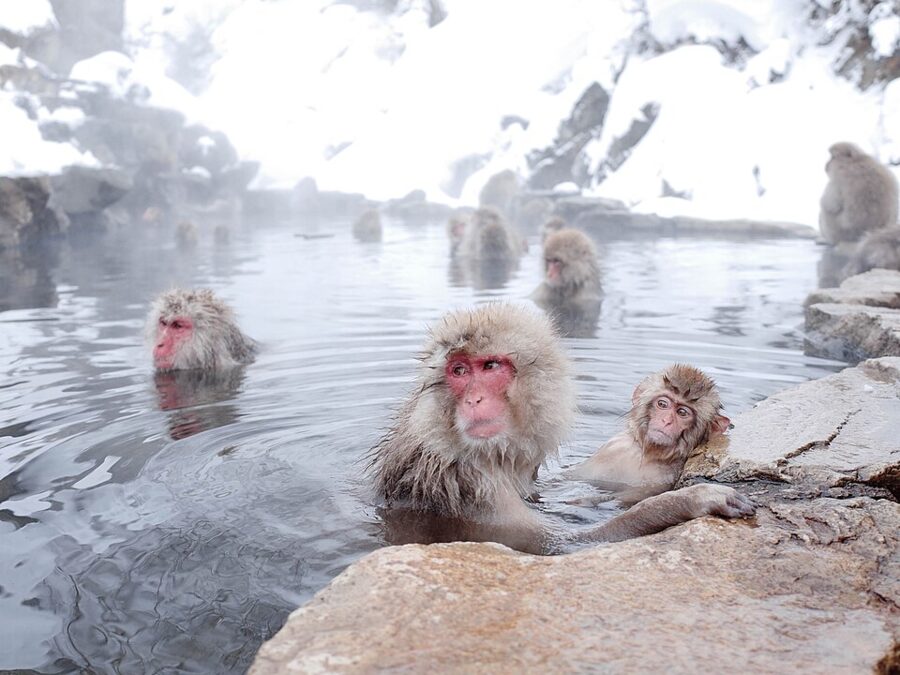

The path from Kanbayashi Onsen to the monkeys is about 2 km and nearly flat, and on a January morning it is where most of the day’s falls happen. Packed snow, polished to ice by the trainers of everyone who walked in ahead of you, with a slope dropping away towards the river for long stretches. At the far end, in a steaming gorge at 850 m, a few dozen wild Japanese macaques sit up to their chins in a hot pool and ignore the crowd entirely.
That is the whole trick of Jigokudani Yaen-koen (地獄谷野猿公苑), the Jigokudani Monkey Park in Yamanouchi, northern Nagano. There are no cages and no fences, the monkeys come and go from the forest as they please, and the only thing between you and some of the most photographed animals in Japan is a walk through cedar woods and a ticket window. The walk is easy. The logistics around it have changed for the 2026–27 winter, and they are what decide whether the day works.
From 1 December 2026 the park charges more, sells dated tickets online and gives those ticket holders priority at the gate through the winter. From 5 December the direct express bus from Nagano station only takes passengers holding a combined bus and admission ticket. None of it is difficult. All of it is easy to get wrong on the morning.
I’d go on a weekday in late January, sleep in Shibu Onsen the night before, take an early local bus up to the trailhead and be walking by 08:00. That gets you to the gate as it opens at 09:00, ahead of most of the people coming out from Nagano, and leaves the afternoon for the hot springs the monkeys don’t get to use.

Contents7 sections
Who the snow monkeys are
The snow monkeys are Japanese macaques, nihonzaru (ニホンザル), Macaca fuscata. They live across most of Japan, from Yakushima to the northern tip of Honshu, and nowhere else in the world. Hokkaido and Okinawa have none. The northernmost wild population of any non-human primate lives on the Shimokita Peninsula in Aomori, and Jigokudani’s winters are, by the park’s account, of the same order: lows around minus 10°C and snow that lies more than a metre deep in January and February.
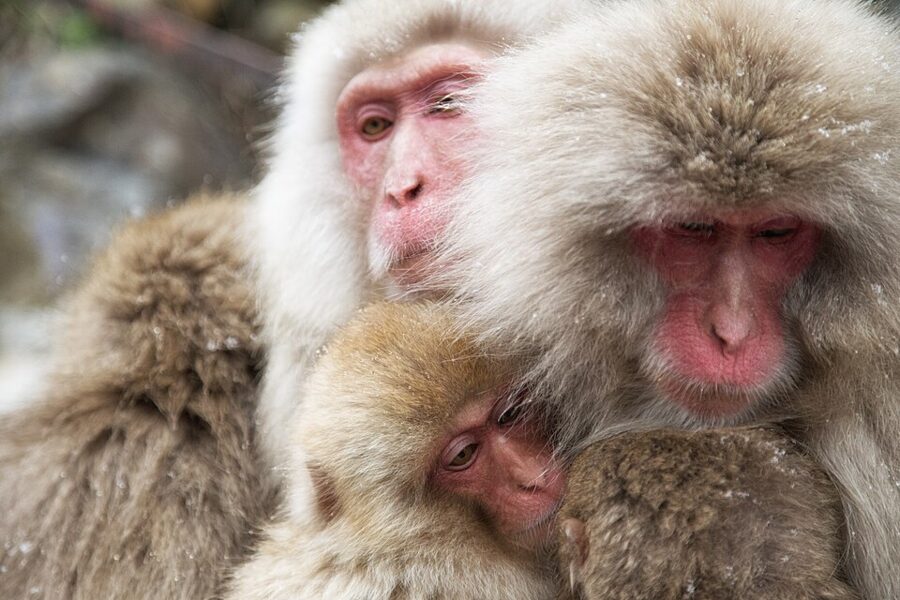
“Snow monkey” is an English nickname, not a species, and it travelled with the photographs. Elsewhere in Japan the same animals raid orchards, wander through mountain villages and sit on the roadside on the way up to Nikko’s lakes, and nobody thinks of them as snow anything.
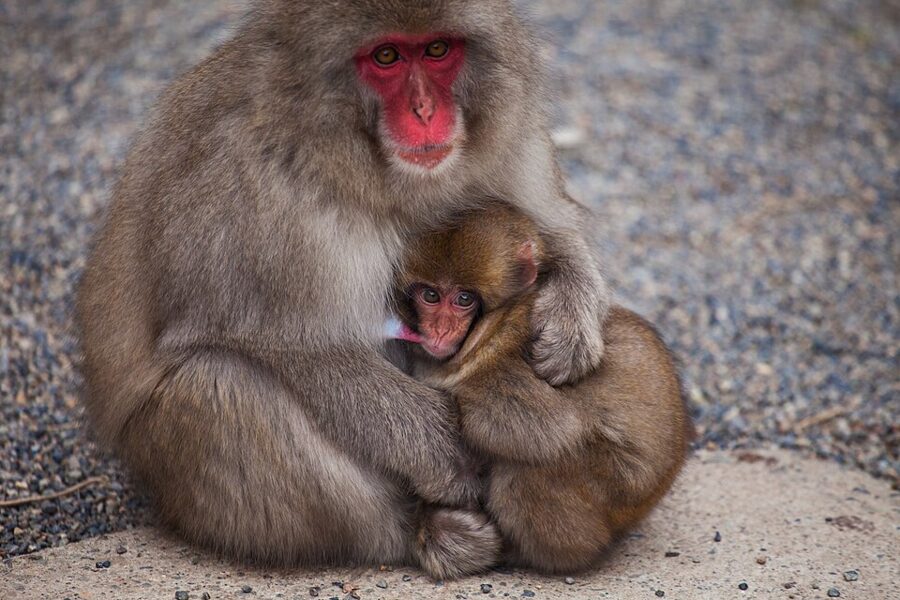

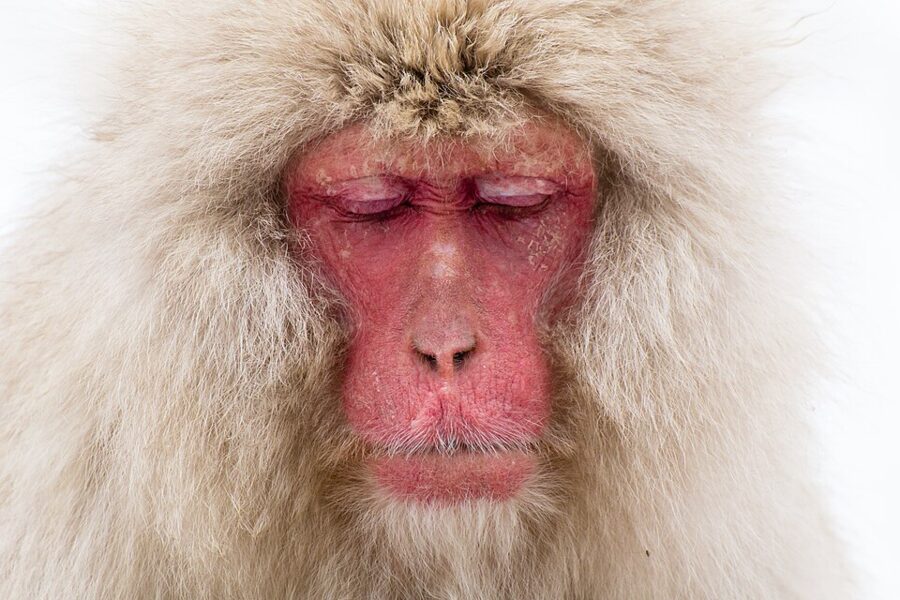
Look at them closely and the adaptations are obvious. The coat is dense and two-layered, the tail is a stub, and the face and backside go deep red in the autumn mating season. They walk barefoot on snow without frostbite because the small blood vessels in the hands and feet close down to save heat. What they cannot do is find much to eat in a Nagano winter, when the forest offers bark and buds and not a lot else.
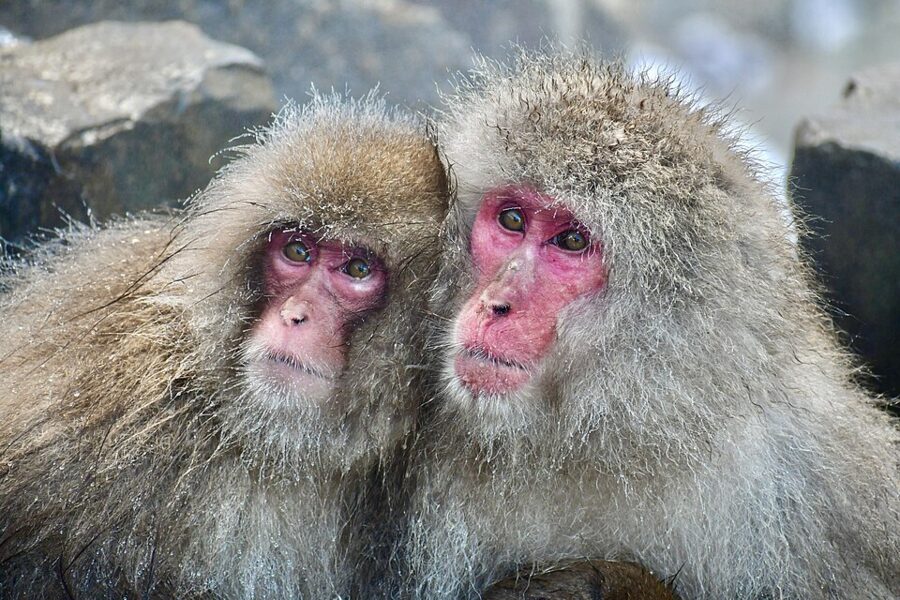

That last fact is the root of the whole story. After the Second World War, logging stripped the deep forest above the valley of much of what the monkeys ate. They came downhill, past the hot springs at Jigokudani, and into the apple orchards around Yudanaka. Farmers asked for permission to cull them, and a licence to shoot 50 was granted.
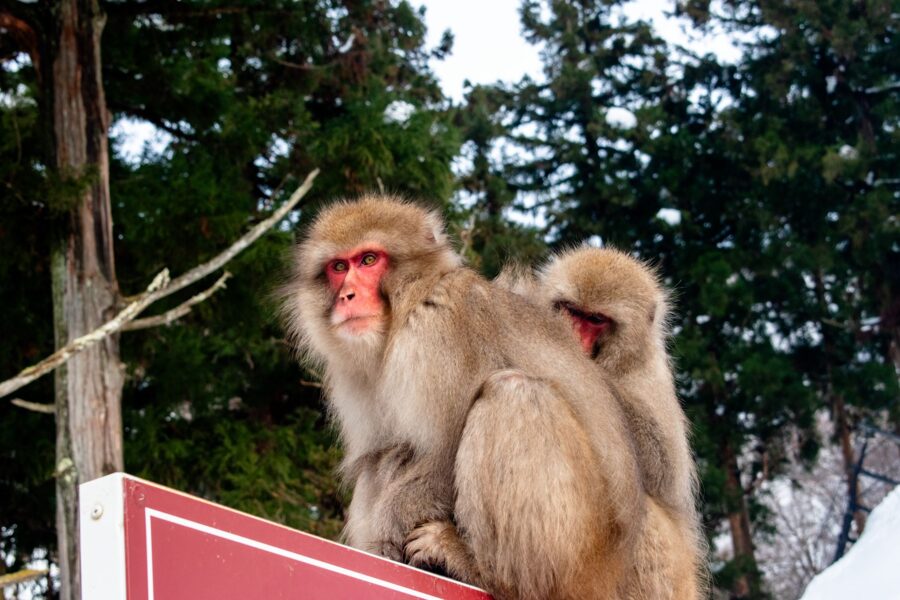
A local man, Hara Sōgo, who would become the park’s first director, argued for feeding them instead, upstream and far from the orchards, on the theory that fed monkeys would leave the apples alone. Japanese sources date the first success to around 1962, when members of the Nagano Electric Railway’s mountaineering club got a wary troop to accept food. The park opened as a company and an observation ground on 3 June 1964, and it is still run by a Nagaden group company today.
Why they get in the water
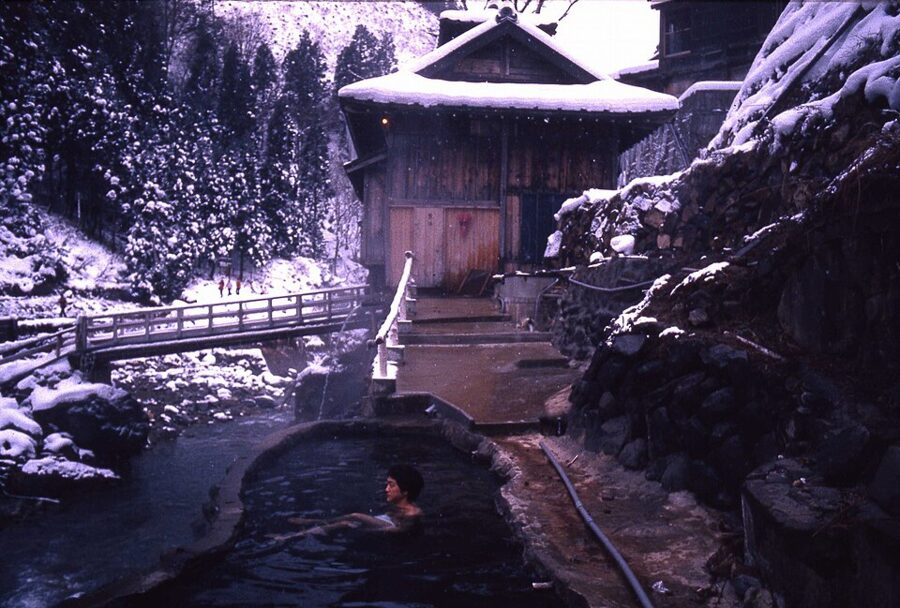
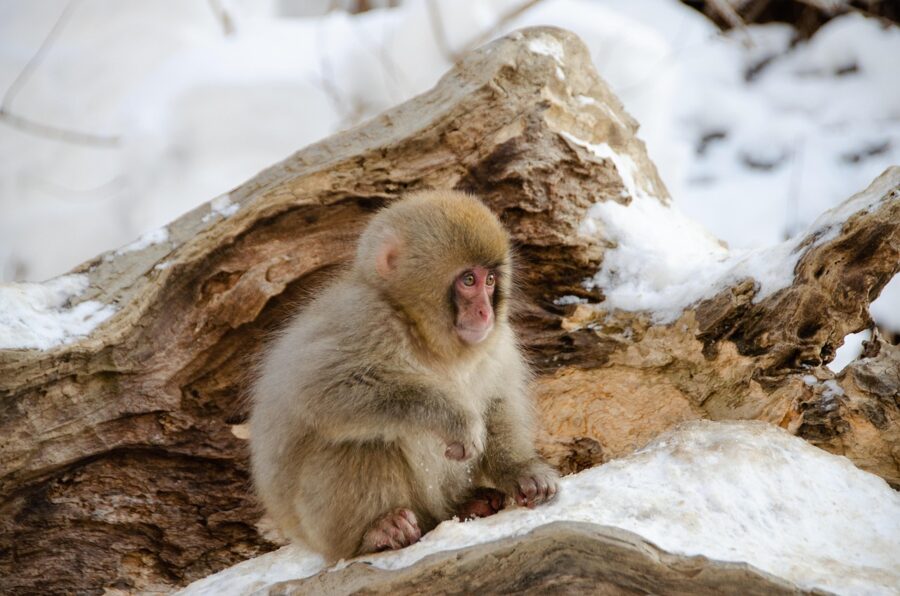
The park tells the origin plainly on its page about the bathing monkeys. Once the feeding worked, the troop spent longer in the valley, with time on its hands between meals. A very young monkey got into the outdoor bath of Korakukan (後楽館), the old inn on the riverbank, apparently found that warm water in winter was a good idea, and others copied it.
Sources give the year as 1963 or 1964. Either way, the inn and its human guests were not keen on sharing, so the park built the monkeys a bath of their own in the gorge. The habit has been passed down the generations since, and Jigokudani is still the only place in the world where wild monkeys are known to bathe in hot springs as a matter of routine.
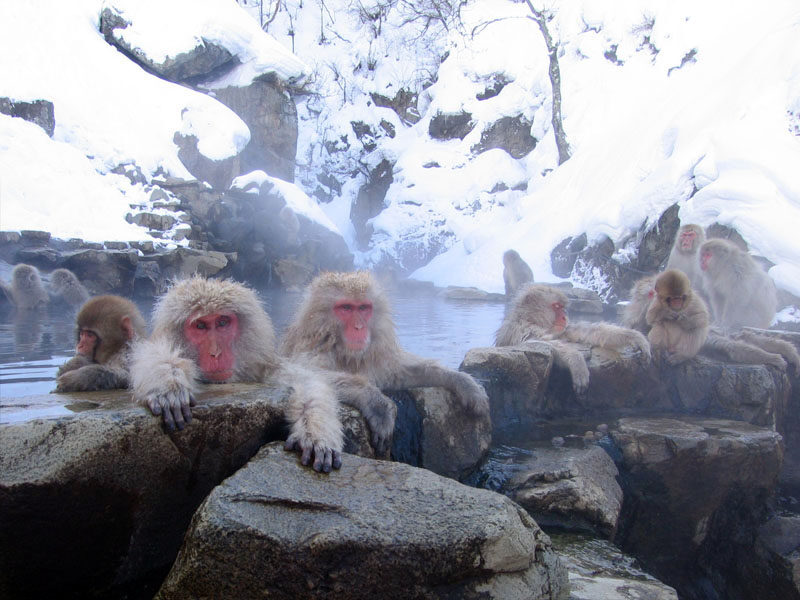

They bathe for warmth, not for cleanliness, and they don’t wash. Warm weather empties the pool. The park is firm that the onsen is a small part of a monkey’s day and not a necessity: eating and the endless business of the troop come first, and some individuals never bother with the water at all.
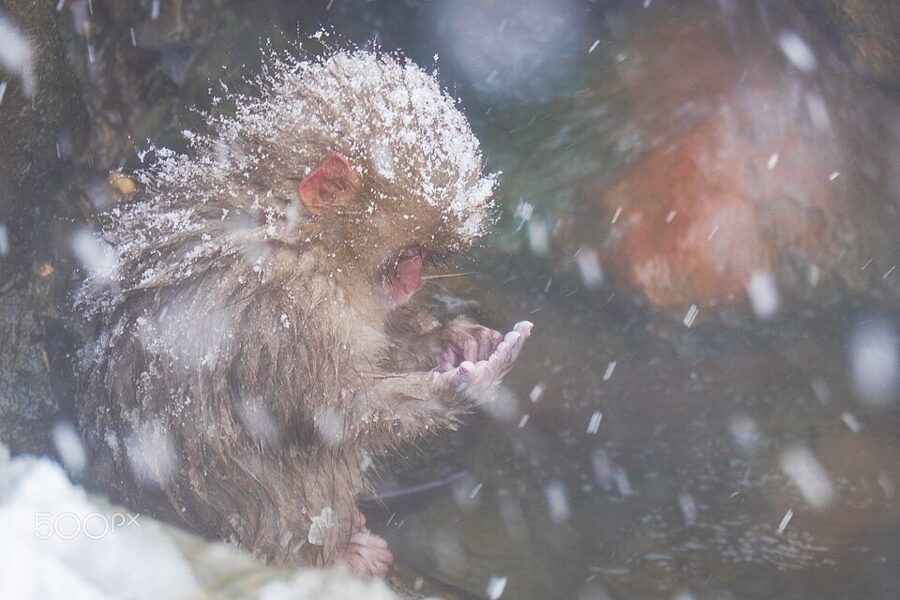

The obvious question is why a wet monkey doesn’t freeze when it climbs out into the snow. Two reasons. Monkeys have few sweat glands, so they don’t lose heat through the skin the way a wet person does. And as Kyoto University’s primate researchers explain it, only the long outer hairs get soaked; the underfur stays dry, and a shake throws most of the water off.
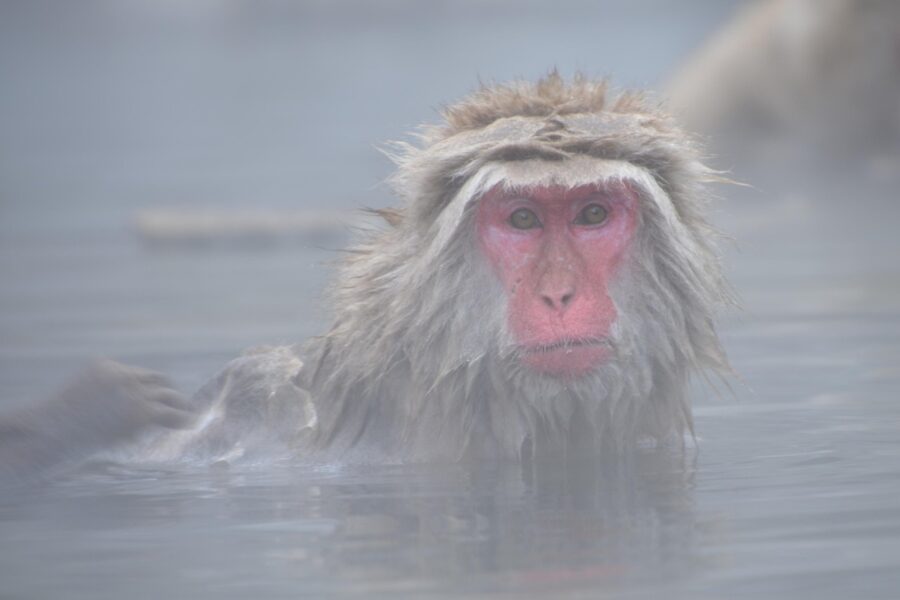
The bathing has a measurable effect. Researchers from Kyoto University’s primate institute published a study in 2018 comparing stress hormone levels in the troop’s adult females through the winter, and found them lower in the monkeys that bathed. Bathing also seems to be mostly a female and juvenile habit. Adult males rarely get in, and the usual explanations are that they need to stay ready to react, and that a wet coat makes a male look smaller than he would like.
Troop life and the Dragon King
A troop of Japanese macaques is several adult males, two to three times as many adult females, and their young. Troops range from a few dozen to, rarely, more than a hundred, and Jigokudani’s was put at around 160 in 2012, of which 50 or 60 used the bath. Males leave the troop they were born in and drift between troops for the rest of their lives, sometimes alone for years. These solitary males are hanare-zaru, and in autumn they hang around the edges of a troop looking for a chance to mate.
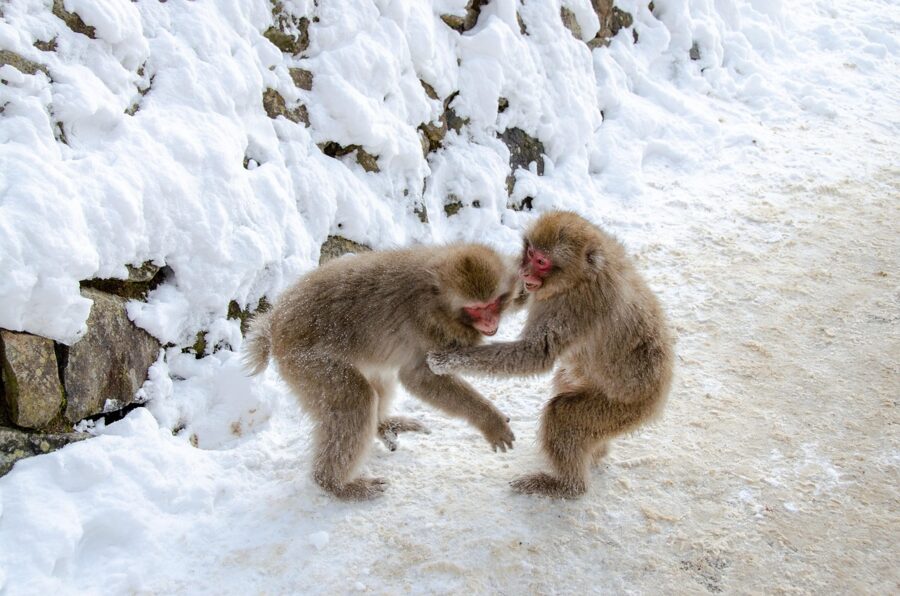
Visitors always ask which one is the boss. The park’s page on monkey society spends some effort taking the idea apart: there is a top-ranking male, but he is not much bigger than the rest, rarely throws his weight around and usually sits quietly in the shade where you won’t spot him. He does front up to outside threats and stares down strange males. Succession usually happens without a fight, when the top male simply leaves and everyone below moves up a place.
The park honours each top male with the title ryu-oh, Dragon King, and keeps portraits of the line in its small information room. Look there for the current holder’s name rather than trusting an old article. They change, and the names that circulate online go out of date.
The park: hours, fees and the new ticket rules
The park is open every day of the year. Summer hours, April to October, are 08:30–17:00; winter hours, November to March, are 09:00–16:00, and the park asks you to arrive at least 30 minutes before closing. It can close early or shut for the day without notice for weather, for monkey behaviour or for natural disasters, and it says so on its guide page.

Admission went up on 1 December 2026, in the park’s words because of rising running costs.
The new admission fees are ¥1,000 for an adult (18 and over) at the gate and ¥500 for children from elementary to high school age, or ¥880 and ¥440 bought online in advance. Children under six are free with a guardian. Groups of 20 or more pay ¥840 per adult at the gate or ¥740 online, and an annual pass is ¥6,000. Until 30 November the gate price was ¥800.
There is no senior discount, discounts can’t be combined, and disability discounts are only available at the ticket window, not online. Payment at the gate is by card or electronic money; QR-code payment apps are not accepted.
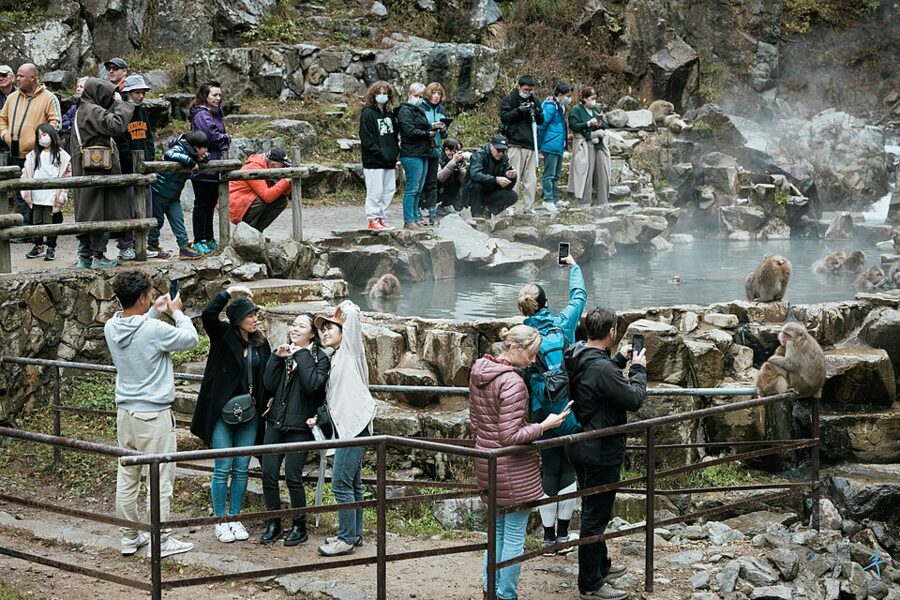
The bigger change is the dated online ticket. The park introduced it because winter crowds were exceeding what the site can hold, with long waits at the gate. Through the winter, December to April, web ticket holders get priority entry, and on crowded days people without one may wait or may not get in at all. Tickets are for a specific date and go on sale up to three months ahead.
Buy one. At ¥120 less than the gate price there is no reason not to, and the queue it saves is outdoors in the snow.
Rules at the pool
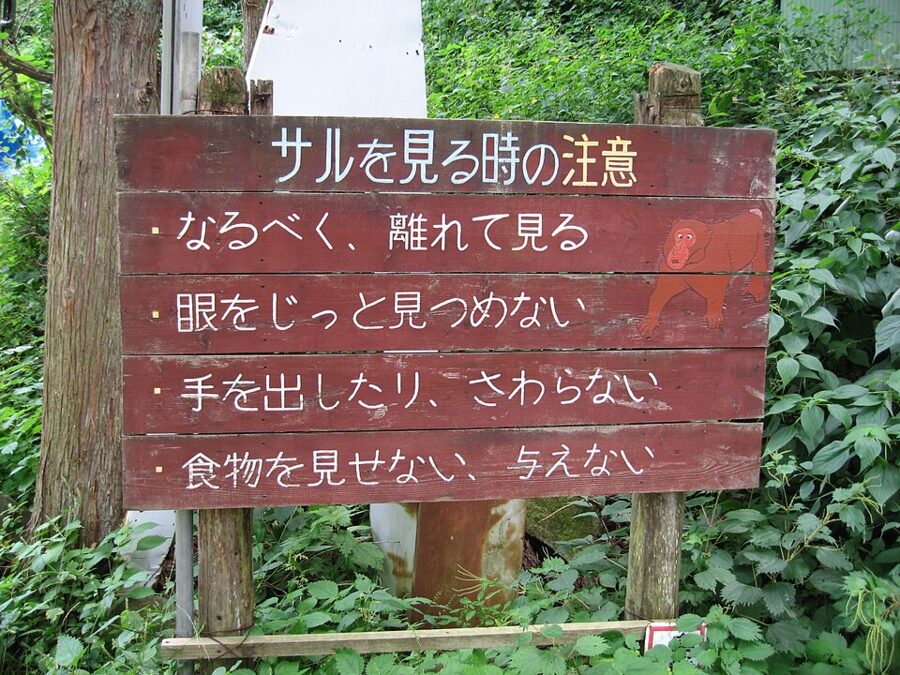

The monkeys are calm because they have learned that people neither feed them nor bother them, and the park’s rules for watching them exist to keep it that way. Don’t feed them or even show them food. Don’t touch them, shout at them or crowd them; a frightened infant calls for help from the adults, and that is when people get bitten. Don’t stare into a monkey’s eyes, because a fixed stare with an open mouth is a threat in macaque.
Photography is allowed, flash included, but not close up. Selfie sticks, drones and putting a camera in or over the water are banned, and so is anything else the park counts as an unorthodox method. No pets of any kind are allowed, guide dogs included, because dogs are the monkeys’ natural enemy. Staff will ask rule-breakers to leave, and they also ask other visitors to point out anyone breaking them.
Keep food in a closed bag and don’t eat on the path or by the pool. A monkey that links a rustling packet with food is exactly the problem the park was set up to solve.
Hell Valley and the gushing spring
Jigokudani means Hell Valley, a name given to steaming valleys all over Japan wherever the ground runs hot; there are better-known ones at Noboribetsu and Tateyama, and most of them sit on the flanks of the country’s volcanoes. This one is the deep, steep-walled gorge of the Yokoyu River, which drains off the Shiga Kogen plateau. Its floor gets almost no winter sun, which is part of why the monkeys value hot water here.
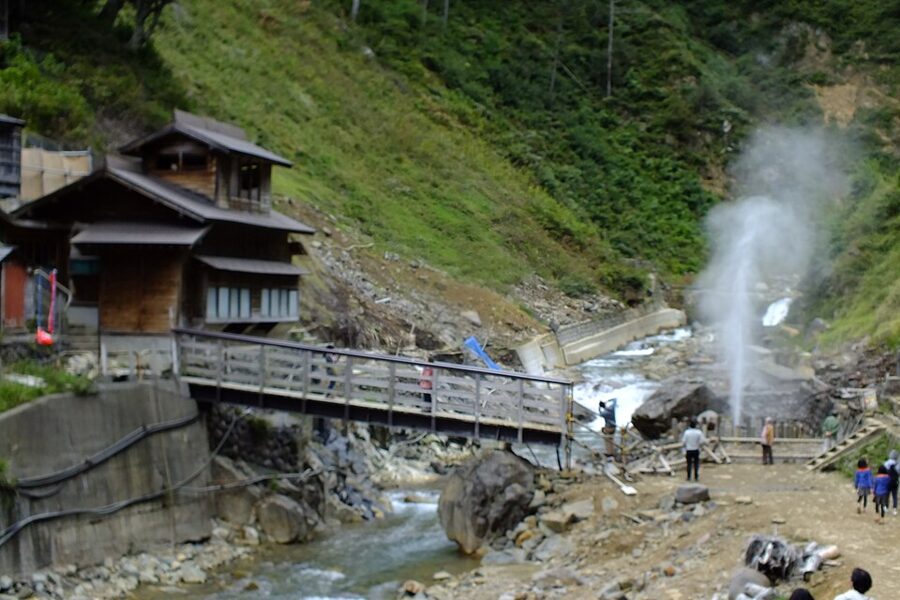

Just below the park, on the riverbed opposite Korakukan, a jet of boiling water and steam shoots up out of the gravel. This is the Shibu Jigokudani gushing spring (渋の地獄谷噴泉), designated a national natural monument on 8 April 1927. It is often called a geyser, but it doesn’t pulse; it runs more or less constantly.
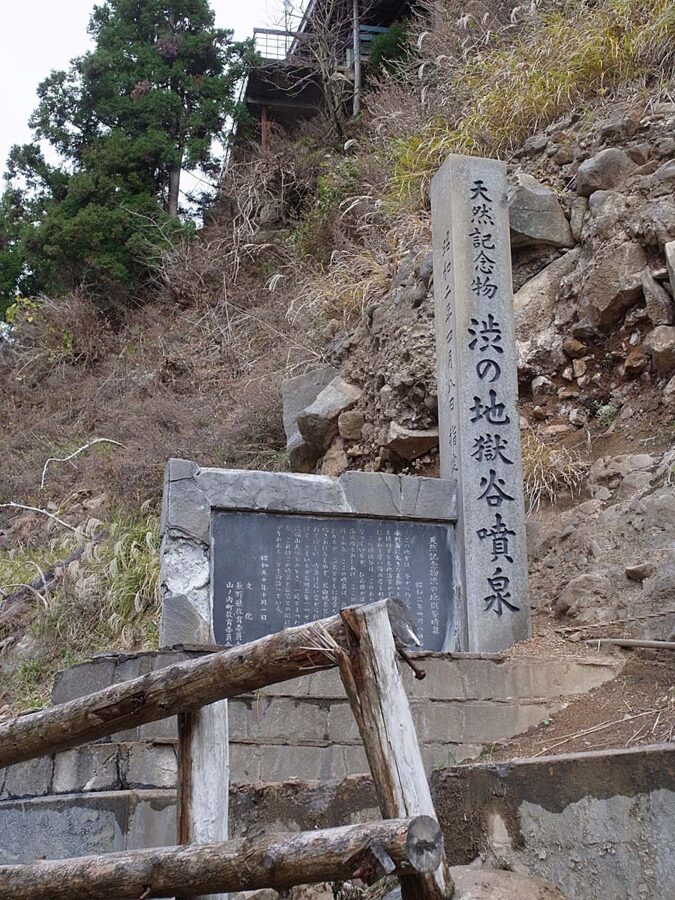

Japanese accounts say the spout weakened over the decades as the riverbed changed, and that it stopped for a time after the great eruption of Mount Asama in 1783. It is still impressive at close range, and you pass it on the way in. Stay on the path: the water is near boiling and the ground around it is not a place to stand for a photo.
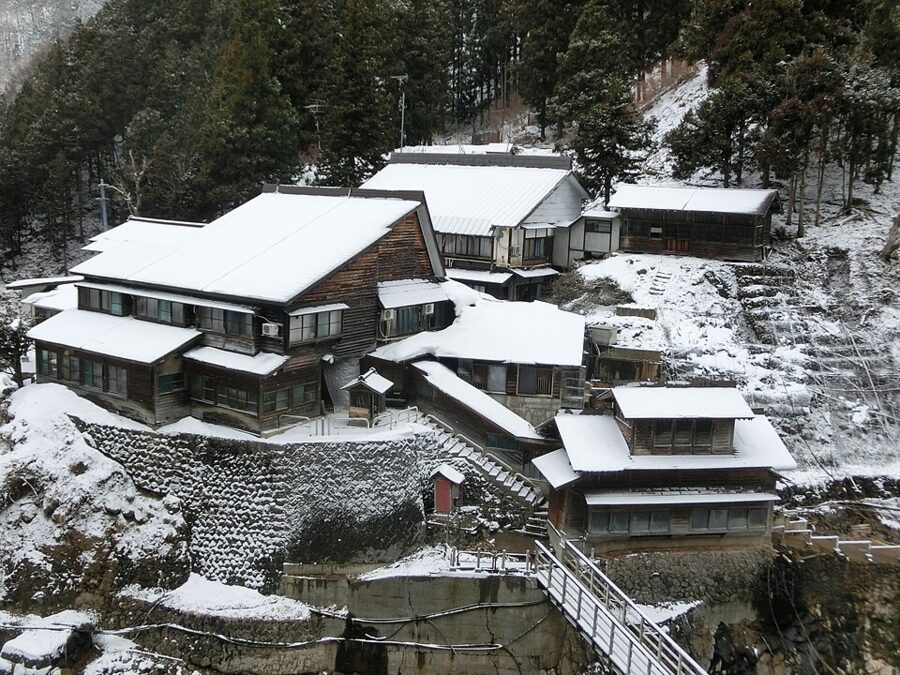
Korakukan itself is a single inn with indoor baths and two mixed outdoor baths on the river, and the monkeys still drop in on its outdoor pool in winter.

The walk in
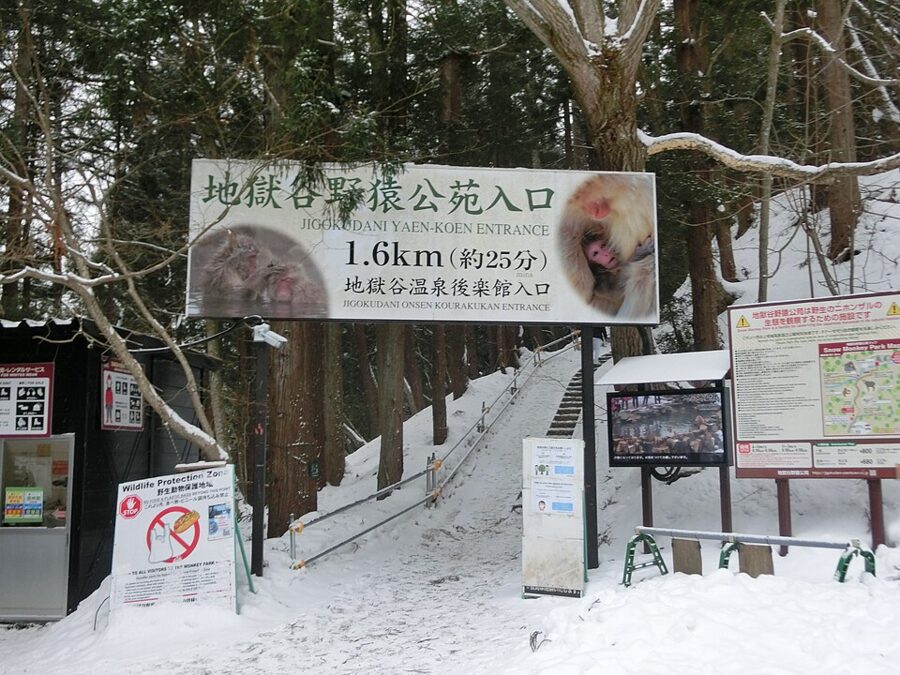
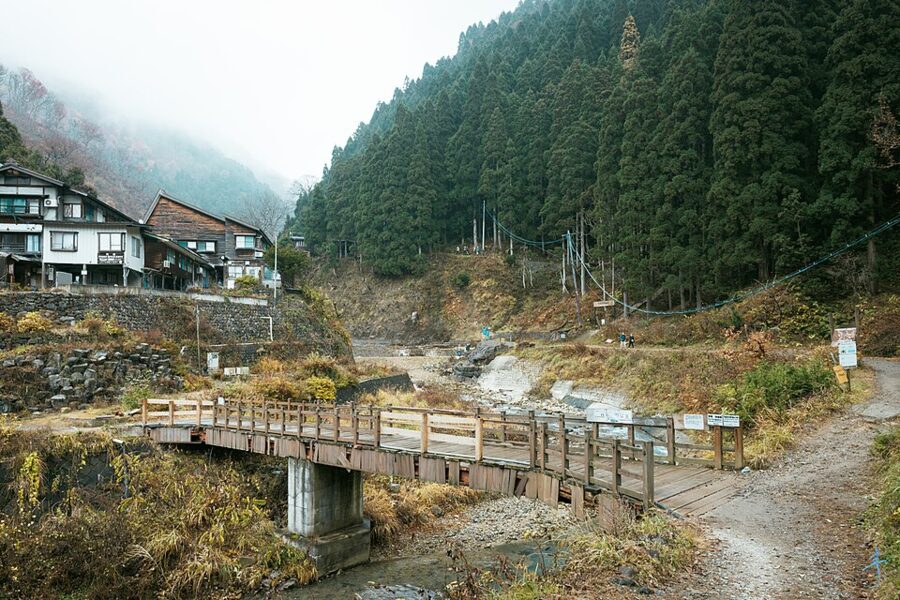
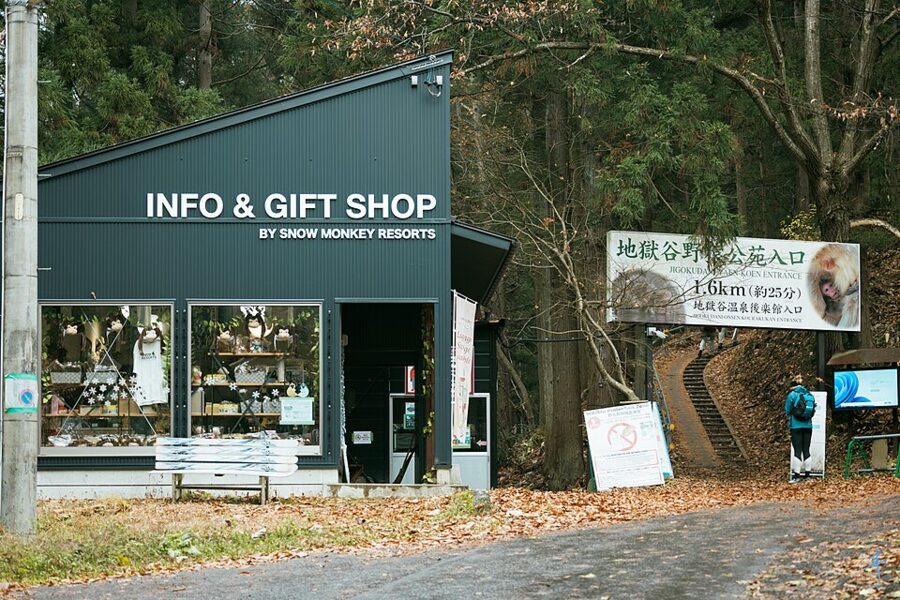
There are two ways to reach the park on foot, and in winter only one of them. The main one is the Yumichi trail (湯道遊歩道), the old hot-water road from Kanbayashi Onsen, which starts a few minutes up the lane from the Snow Monkey Park bus stop and the free car park. The park’s access page gives it as about 2 km and about 30 minutes. The sign at the trailhead says 1.6 km and about 25 minutes.
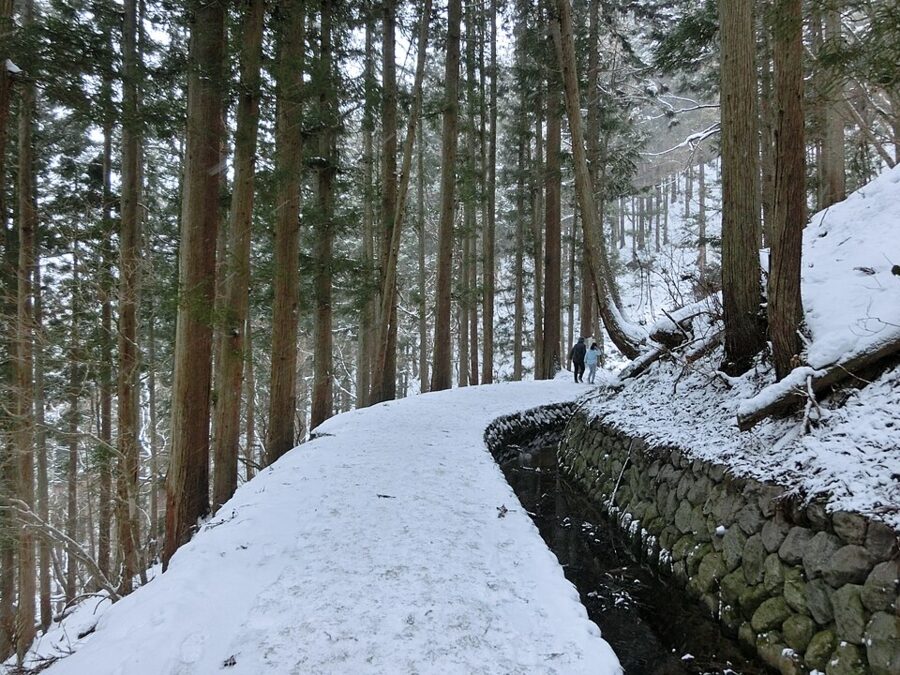
Either way it is a short walk with very little climbing. The trail leaves the lane at the trailhead sign, climbs gently through cedar plantation on a broad track, and then runs along the side of the valley, mostly level, with a few short rises and drops. Near the end it passes a few buildings, drops to the river past Korakukan and the gushing spring, and finishes with a flight of steps up to the gate. The final stretch is the steepest part of the day and it is still only a few minutes.
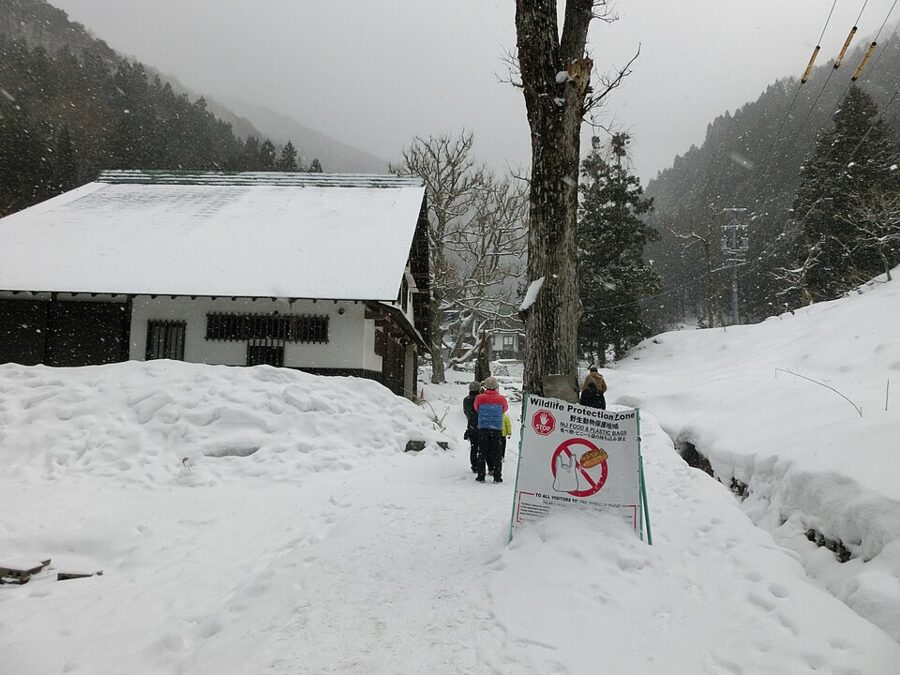
Allow 30–40 minutes each way in winter, longer if you stop to look at monkeys on the path, which is likely. The park mentions Japanese serow and squirrels along the trail as well, and in deep winter the serow come down to the sunny south-facing slopes where they are easier to spot than at any other time of year.
In deep snow and ice
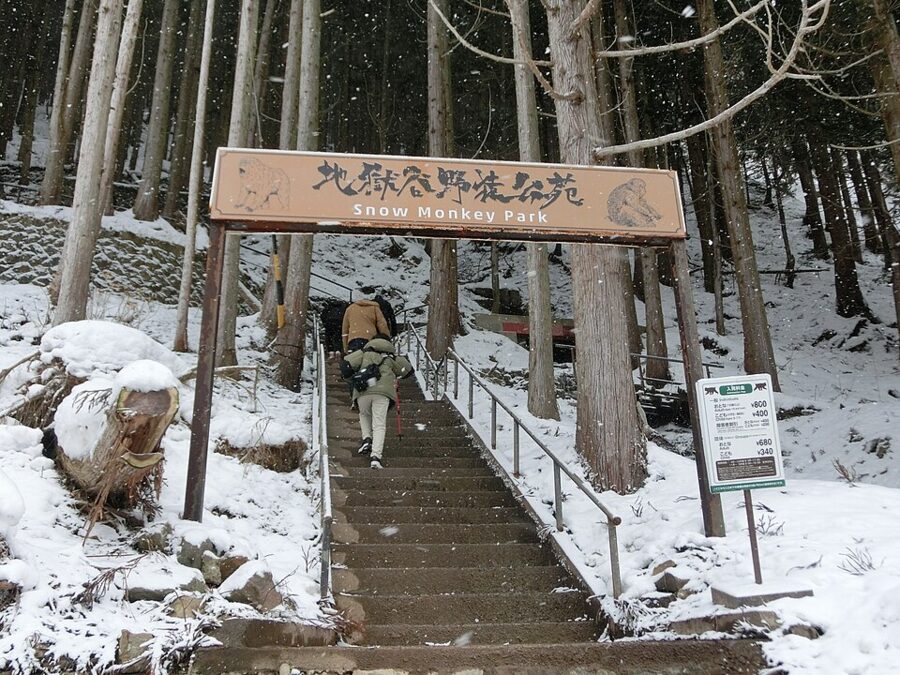
The trail is open all winter and well used, so you won’t be breaking trail. The problem is the opposite. Hundreds of people a day compact the snow into a hard, smooth surface that goes to ice on clear cold mornings and to slush and meltwater on mild afternoons, and the edge drops towards the river on the valley side.
The park recommends rubber or snow boots in winter and buying simple crampons in advance. Take that literally. Strap-on chain spikes of the kind sold in Japanese outdoor shops do the job; full mountaineering crampons are overkill. In the green season, hiking shoes or trainers are fine, and the park asks you not to come in sandals because of nettles, pit vipers and bees.
Dress for standing still. The walk warms you up, then you stand for an hour at the bottom of a sunless gorge; a hat, gloves you can work a camera in and a spare layer matter more than anything you wear on the walk. There is a small information and gift shop at the trailhead, open from early October to late May, with winter rentals for those who arrive in the wrong shoes.

No part of the route is accessible by wheelchair or with a pushchair. Both approaches are unpaved, uneven and include steps. With small children, hold hands near the pool; the park asks guardians not to let go.
The road route from Shibu
The second approach is a narrow forest road from Shibu Onsen, which leaves the town beside Onsen-ji temple and climbs about 2 km to the Jigokudani car park. From there it is about 15 minutes on foot to the park. The car park costs ¥500, buses and large vehicles can’t use the road, passing places are few, and the whole road is closed in winter.
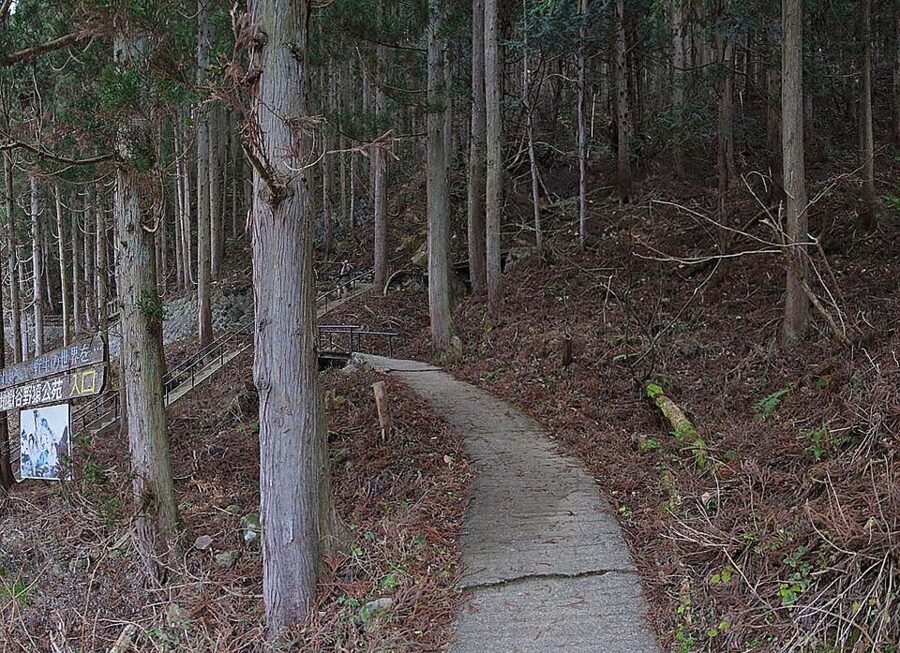

In the snow-free months it makes a good walk out and back from Shibu, about 2.5 km each way by the figure Shibu’s inn association gives, and it lets you see the gorge from the downstream end. In summer the park suggests a taxi from Yudanaka station to the Jigokudani car park. In winter, forget it and use Kanbayashi.
When to go
The monkeys use the bath in the coldest months, December to March. January and February are the months the photographs are made of: snow piled on every rock, steam lying on the water, monkeys with frost on their faces. Heavy snow usually arrives in mid-December, and in the coldest weeks the snow on the ground passes a metre, with 40–50 cm in a single night described as normal.
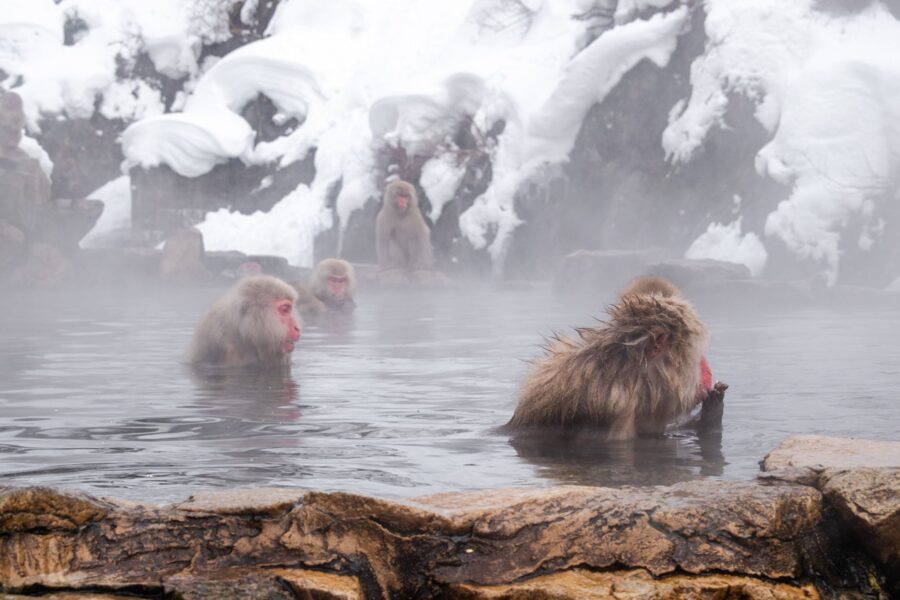
The colder the day, the more monkeys in the pool and the longer they stay. A mild grey day in February can be disappointing; a clear frozen morning after a snowfall is the one to be there for. Watch the forecast for Yamanouchi rather than for Nagano city, which sits about 500 m lower and can be wet when the valley is white.
Time of day
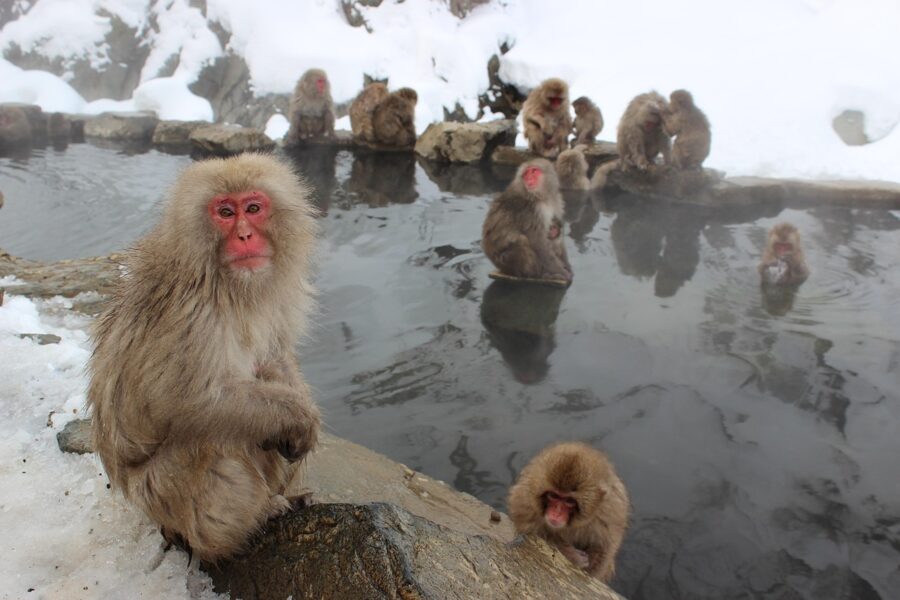
The monkeys spend the night in the forest and come down to the park after daybreak, then drift back up in the late afternoon. The park’s weekly forecast for late November 2026 put their arrival at 09:00–10:00 and their departure at 14:30–15:30, and suggested visiting between about 10:00 and 15:30. In deep winter they are more dependable, but the pattern is the same.
The park staff feed the troop at irregular times chosen by the monkeys’ condition and the weather, and they deliberately don’t publish the schedule. The feeding exists to keep the monkeys observable, not as a show. If you want the pool with the fewest people around it, the first hour after opening on a weekday is the best bet; if you want the most monkeys in the water, late morning on a very cold day.
Weekends, holidays and Lunar New Year
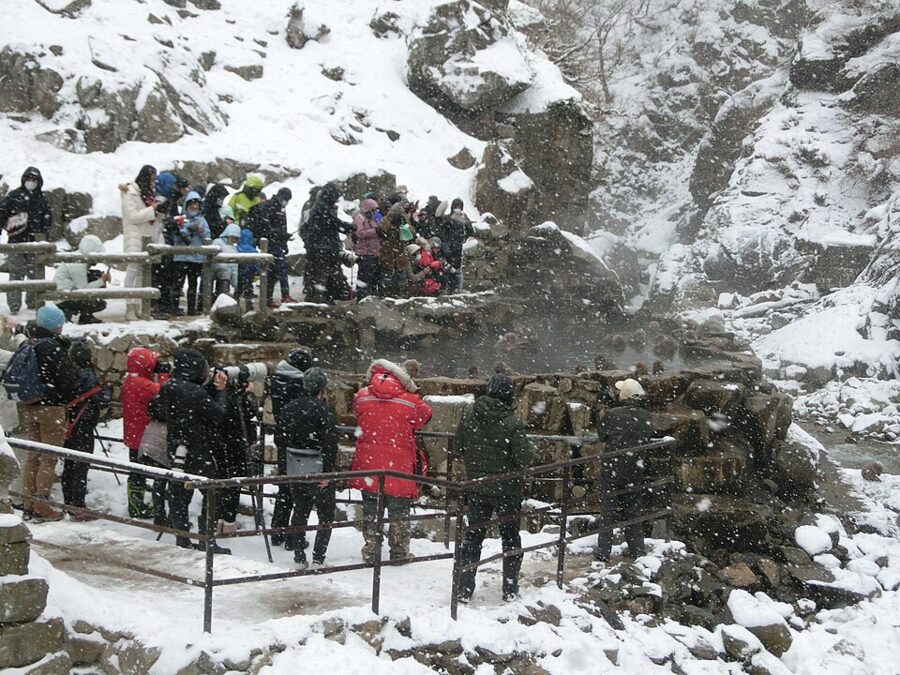
Winter weekends, the year-end and New Year holidays and the Lunar New Year period are the worst days to go. Lunar New Year falls on 6 February in 2027, and the week around it is reliably one of the most crowded of the season. The park’s home page carries a crowd forecast calendar, graded from not crowded to very crowded, and it is worth checking before you fix a date.
On a crowded day you get a line several deep at the rail. A weekday in late January, or early March when the snow is still deep, is a different and better day.
Spring, summer and autumn
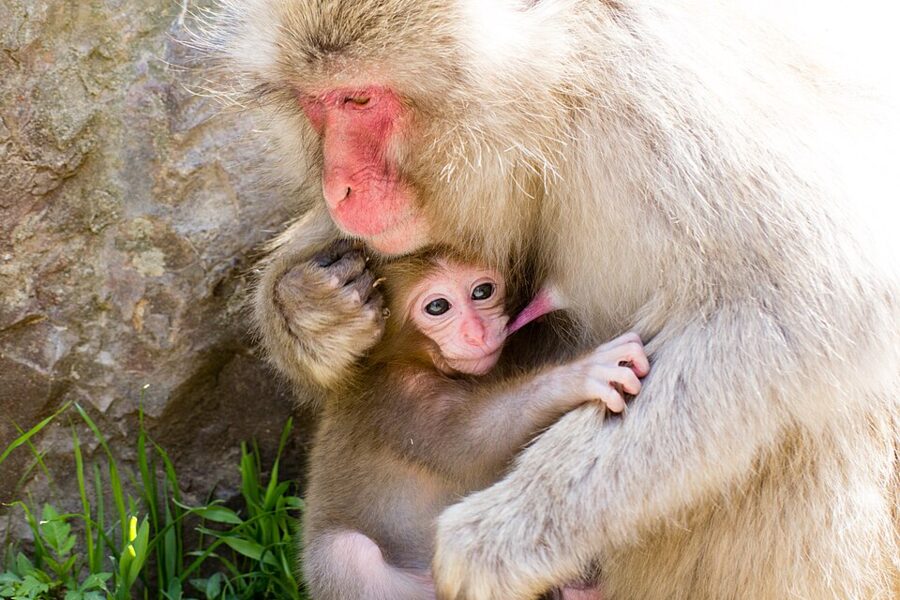

The park is open all year, and the green season has its own reasons to go. Spring, from April, means melting snow, new leaves and the birth season, with the peak of births from late April to June. You will see very small infants clinging to their mothers. You probably won’t see much bathing.
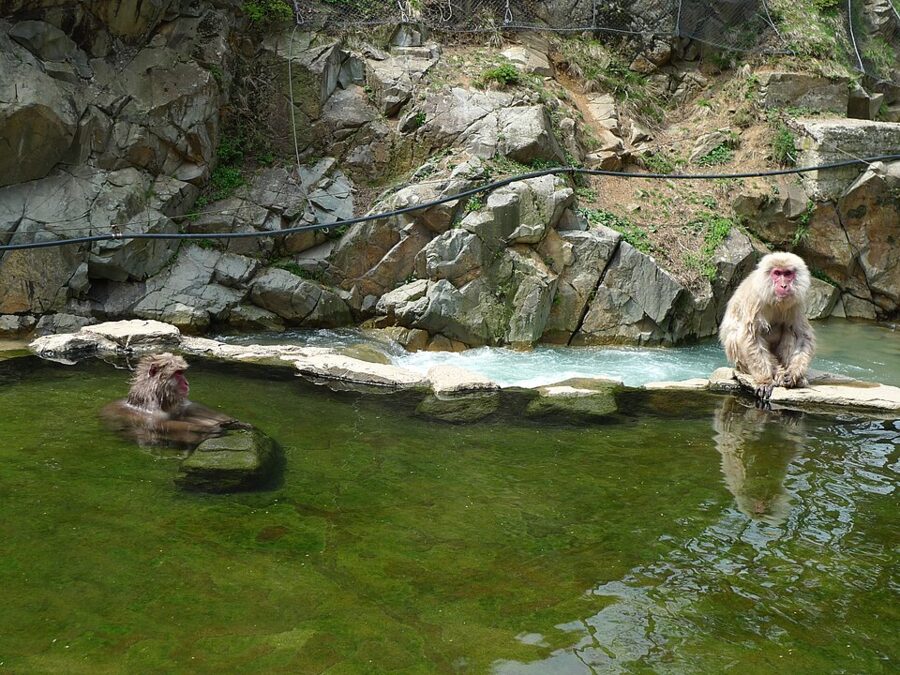

Summer at 850 m rarely passes 30°C, and the adult monkeys spend the hot part of the day lying in the shade while the young ones play. The rainy season runs through June into July. Bring a light jacket, mosquito repellent and proper shoes.
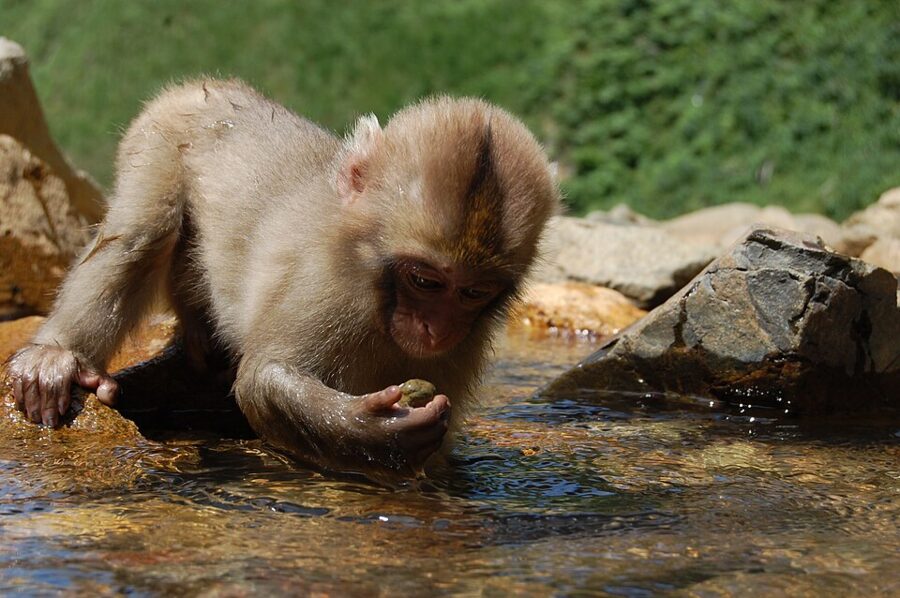
Autumn is the season to be warned about. September and October are the busiest months of the monkeys’ year, when the forest is full of nuts and fruit and the troop is fattening up for winter, and the park says visits are particularly sporadic then. There are days when they don’t come down at all. The mating season follows, with red faces and a tense atmosphere in the troop, and the valley’s autumn colour peaks from mid-October.
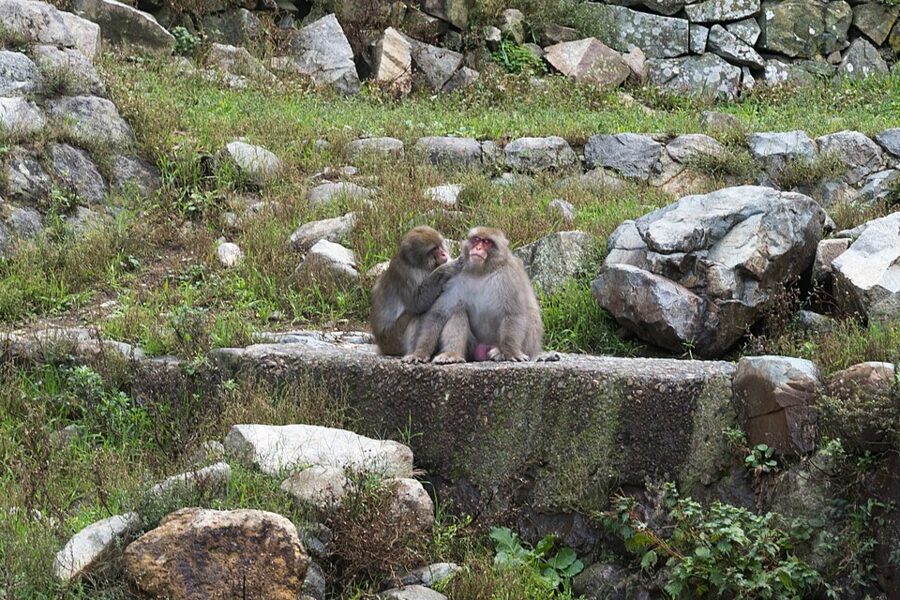

Whatever the season, check before you go. The park posts a weekly forecast of when the monkeys are expected, a live camera image refreshed through the day and daily updates on Facebook and X about whether they are there. Nagaden’s combined tickets say plainly that there is no refund if the monkeys don’t show.
Getting there
Everything starts at Nagano, which is 79 minutes from Tokyo at best on the Hokuriku Shinkansen. From Nagano there are two ways to the trailhead by public transport: the Nagano Electric Railway (Nagaden) to Yudanaka and a local bus, or the direct express bus from Nagano station. Both are run by Nagaden companies, which also own the park.
Train to Yudanaka, bus to the trailhead
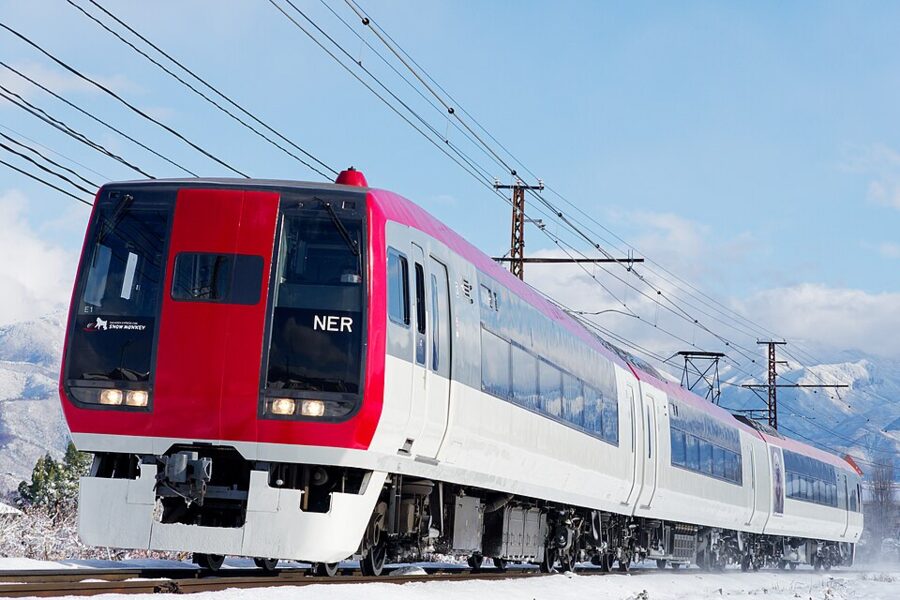
Nagaden’s Nagano Line runs from its underground platforms below Nagano station to Yudanaka, 33.1 km away. The adult fare is ¥1,660, and the limited express adds a flat ¥100 on any journey. Two kinds of limited express run through the middle of the day: the 2100 series Snow Monkey, the old Narita Express trains, and the 1000 series Yukemuri, former Odakyu Romancecar sets with an observation seat at the front. Part of each train is reserved and costs another ¥300; the rest is unreserved.
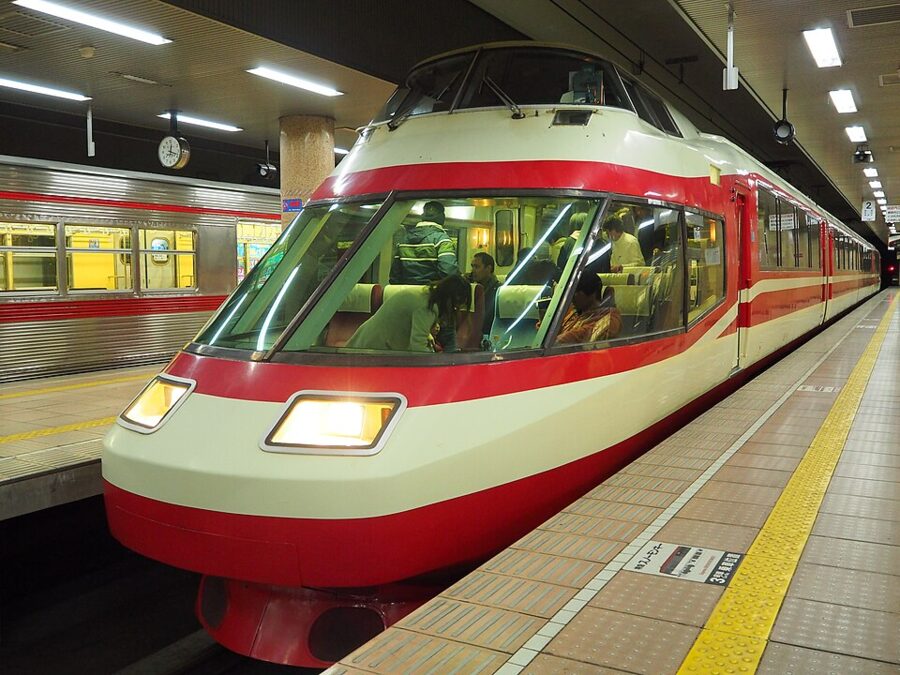
Limited expresses don’t run every hour, so check Nagaden’s ticket and pass page and the station timetables before you go. The line’s own day passes include the limited express surcharge. Nagaden also sold a Snow Monkey Pass, a one-day train pass with a return bus ride from Yudanaka to the trailhead and park admission, for ¥4,800; the 2026 edition was sold April–September and no winter edition had been announced by late November, so ask at the station.
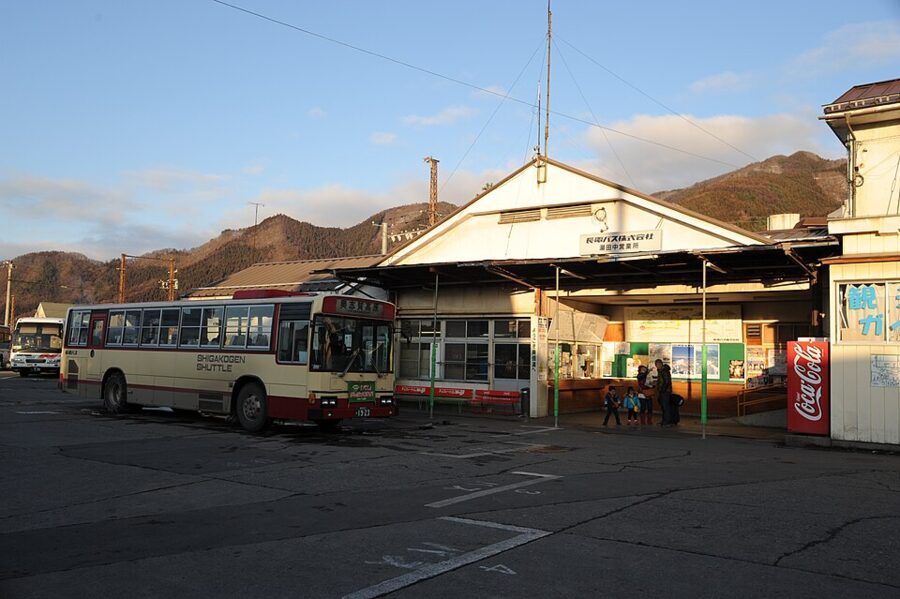
From Yudanaka station, local buses run up through Shibu Onsen to the Snow Monkey Park stop in about 10 minutes; the winter timetable has the first departures shortly after 07:00. Get off at Snow Monkey Park, walk up the lane past the hotels of Kanbayashi Onsen to the trailhead, and the walk starts there.
The Snow Monkey express bus from Nagano
For the 2026–27 winter, Nagaden Bus has split the Snow Monkey Park service off its Shiga Kogen express. The winter timetable, from 5 December 2026 to 5 April 2027, runs a direct Express Snow Monkey Park Line (route Ex24) from stop 24 at Nagano station’s East Exit every 20–30 minutes. The first leaves at 08:00 and the last at 13:30, the ride takes 50 minutes, and buses come back from Snow Monkey Park between 11:00 and 17:00. The Shiga Kogen express (Ex23) no longer stops at Snow Monkey Park in winter.
The catch is the ticket. From 5 December you can only board with a Snow Monkey Pass for Bus, a combined bus and admission ticket: ¥6,800 for an adult return or ¥3,800 outbound only in winter, half price for elementary school children. It is sold online from 90 days ahead until the day before. Same-day tickets are sold at the Aruyo bus information counter on the ground floor of the East Exit, but on busy days such as the New Year holidays they stop once the online quota is gone, and there is no paying on the bus.
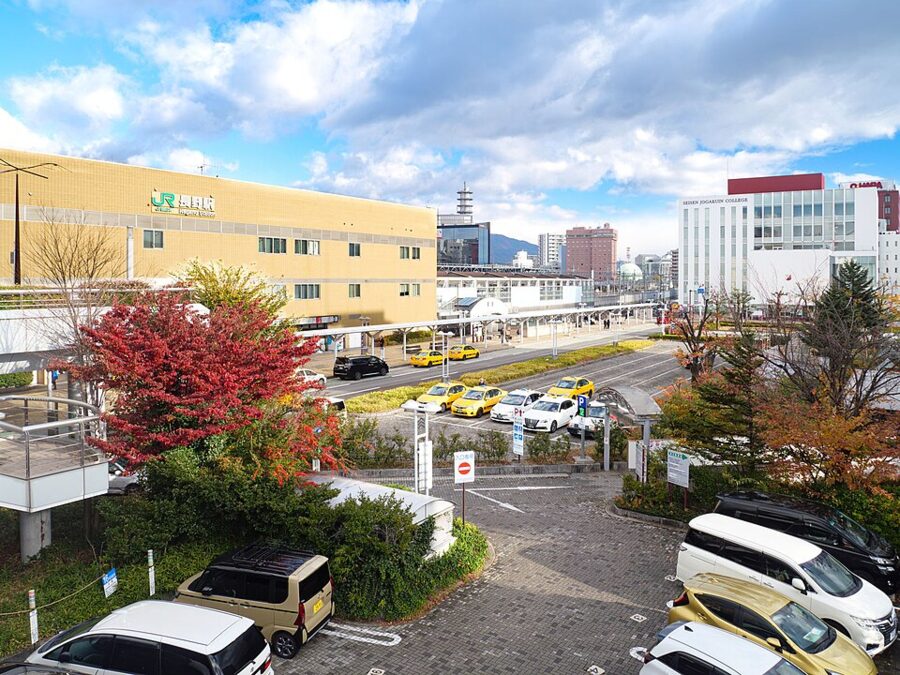

Seats are first come, first served in the order people queue at stop 24, and a full bus means waiting for the next. If you are staying in Nagano and going on a weekend, buy the return ticket online days ahead and be in the queue early. On a weekday, the train-and-local-bus route costs less and is less exposed to a sold-out morning.
Driving
There is a free car park for the park at Kanbayashi Onsen, about 16 km along Route 292 from the Shinshu-Nakano interchange on the Joshin-etsu Expressway, and the walk starts from there. It fills, and the park asks people to come by public transport where possible. The forest road from Shibu to the Jigokudani car park is closed all winter. Winter tyres or chains are needed for any driving in this valley from December to March.
Around it: Shibu, Yudanaka and the snow country
The monkey park takes two to three hours with the walk. The rest of the day belongs to the hot spring towns below it, Yudanaka, Shibu, Kanbayashi and several smaller ones, which run together along the valley as Yudanaka Shibu Onsen.
Shibu Onsen and its nine baths
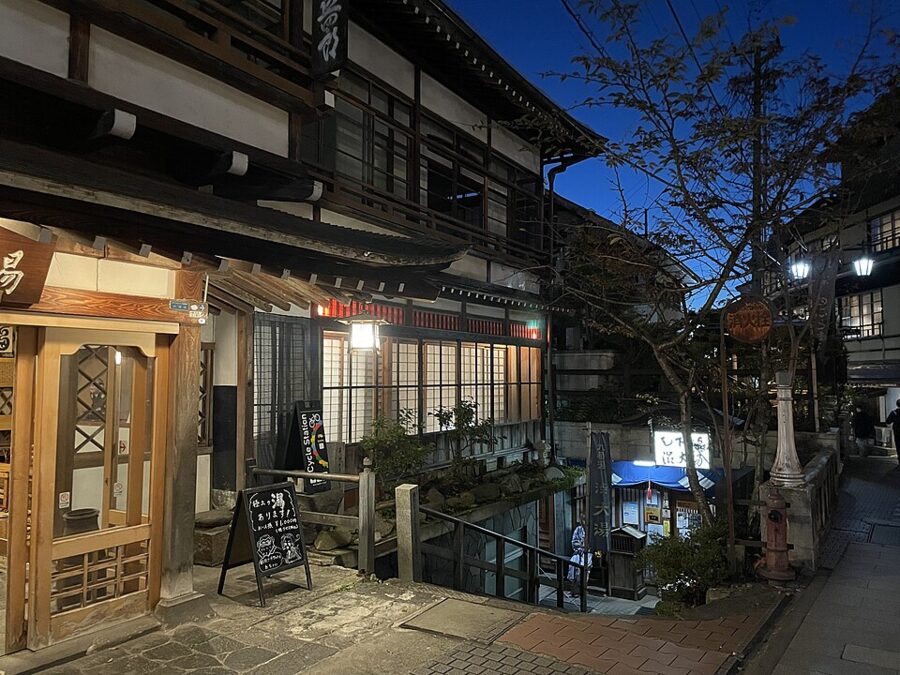

Shibu Onsen (渋温泉) is the place to stay. It is a narrow lane of old wooden inns along the Yokoyu, 2.5 km downriver from the monkeys, and its centrepiece is the circuit of nine public baths, the soto-yu, each from its own source and each said to cure something different. Guests at Shibu’s inns borrow a key that opens all nine, carry a special towel, collect a stamp at each bath and, with all nine done, climb to the Takayakushi temple above Oyu to complete the round. Nine baths, ku, is a pun on washing away suffering, also ku.
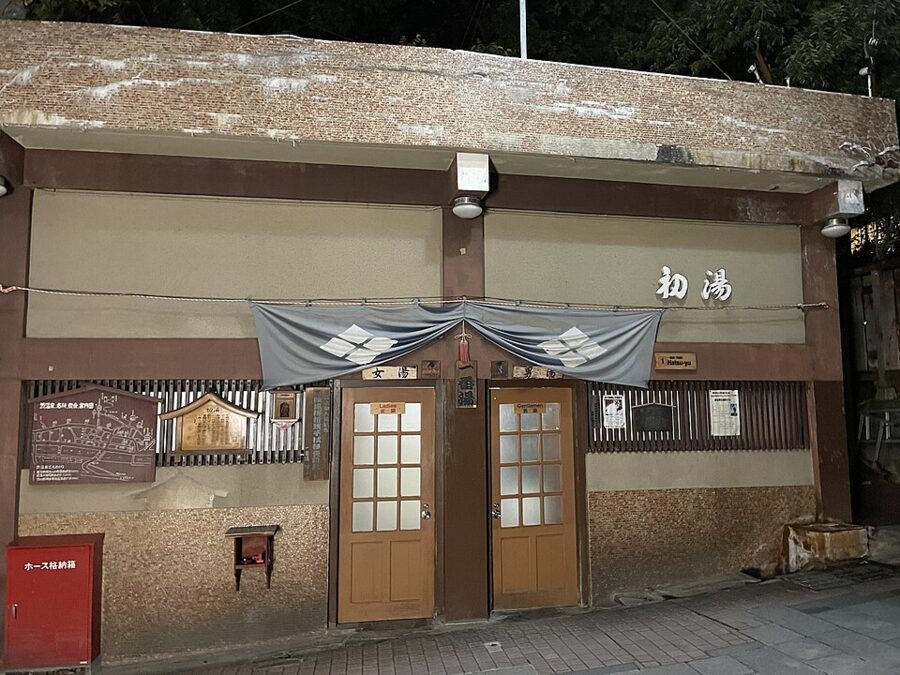

The baths are small, plain and very hot. Several are over 50°C in the tub; there is no shampoo and washing hair is forbidden. Day visitors can’t use eight of them. The exception is the ninth, Shibu Oyu, open 10:00–17:00 for ¥800 an adult, with tickets sold at the tourist information office and at several inns near the bath, which also open the door for you.
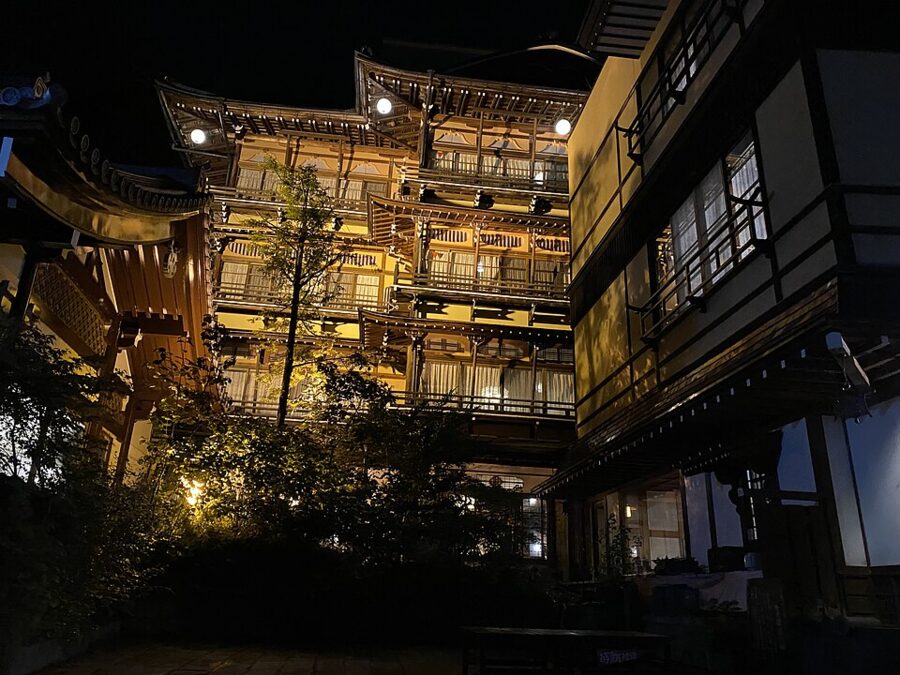

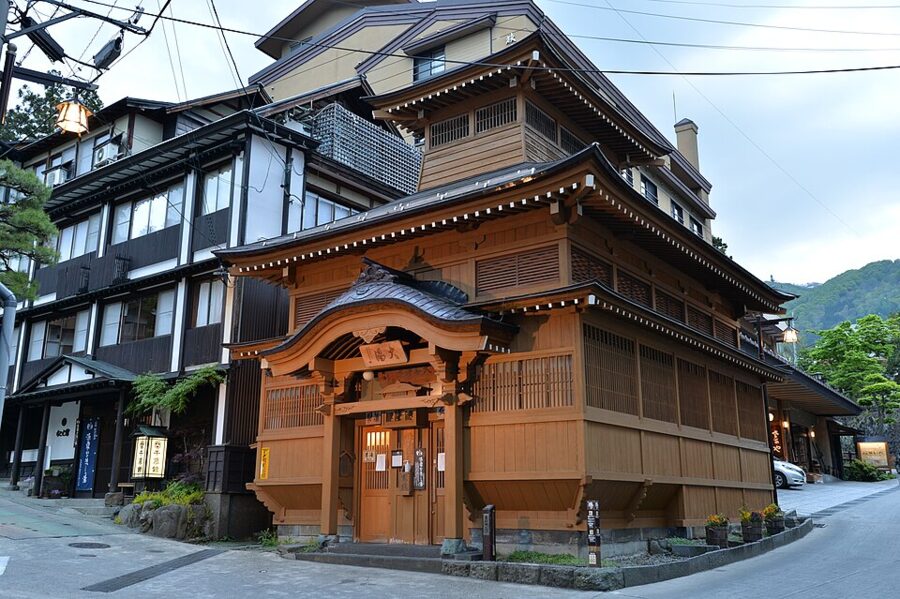
The town’s best-known building is the Saigetsuro wing of Kanaguya (金具屋), a four-storey wooden inn that lights up at night and gets photographed from the lane by everyone who walks past. It is a working ryokan and a member of Shibu’s inn association. Staying at any of Shibu’s inns gets you the nine-bath key, and that is the real reason to sleep here rather than in Nagano.
Yudanaka and Kanbayashi
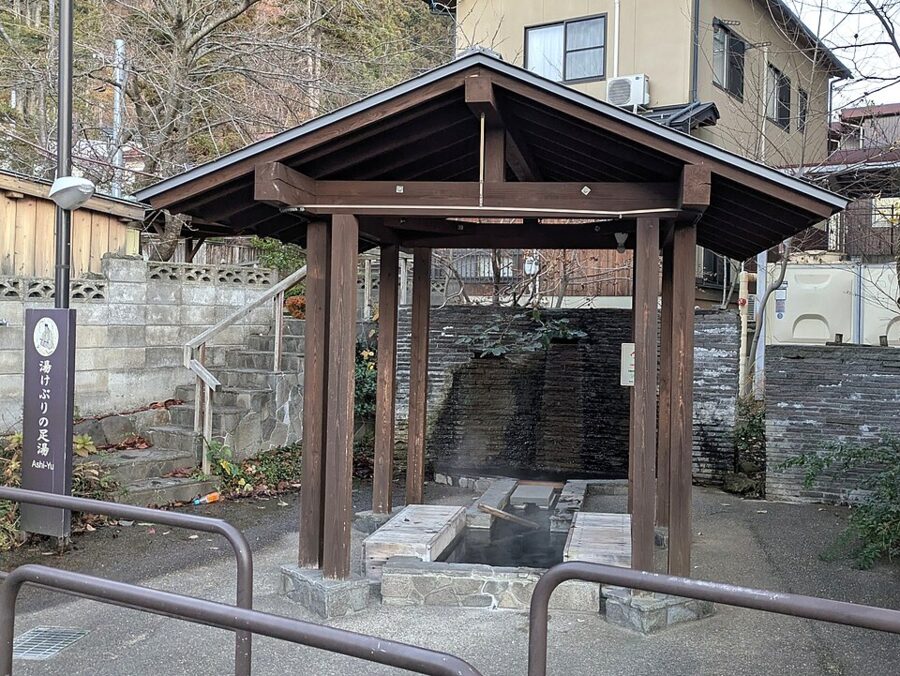

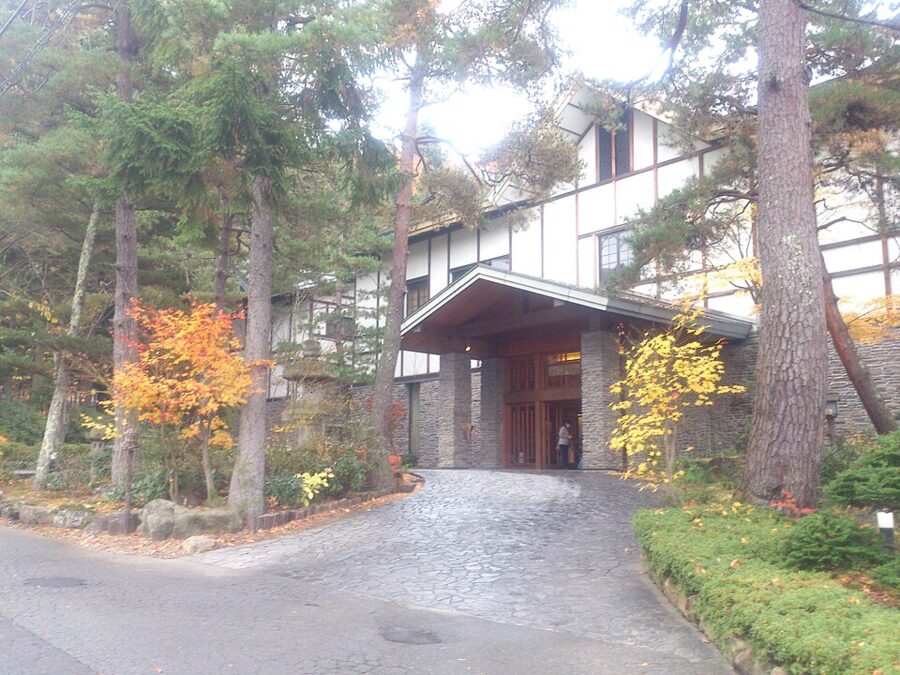
Yudanaka is the railhead and the bigger town, with a day-use bath, Kaede no Yu, attached to the station and free footbaths outside it. Its nine public baths are for residents and guests. Kanbayashi Onsen, at the trailhead itself, is a handful of large hotels in the trees, including Nagaden’s own Kanbayashi Hotel Senjukaku, which has been there since the railway’s founder built a hotel here in 1928. It is quiet, with nothing much at night, and its advantage is that you are on the trail before anyone else.

Ski bases: Shiga Kogen and Nozawa Onsen
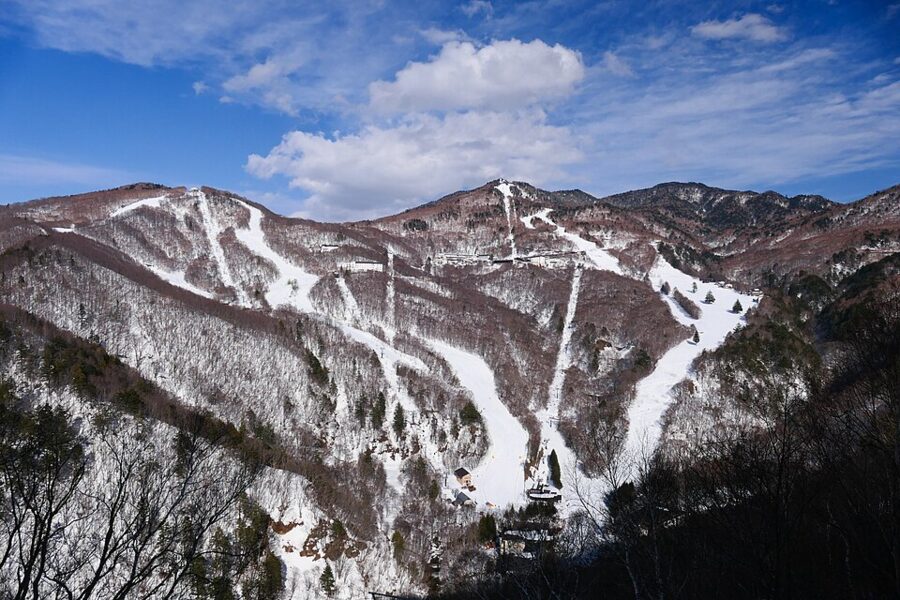
Above the valley, the road climbs to Shiga Kogen, one of the biggest linked ski areas in Japan, spread across a high volcanic plateau; a day at the monkeys fits neatly into a ski trip there. Across the Chikuma valley, Nozawa Onsen combines a big ski mountain with its own public baths and is the other obvious base. Both are covered in more depth in the guide to skiing in Japan, and day tours to the monkeys also run from Hakuba, about 90 minutes away by road.


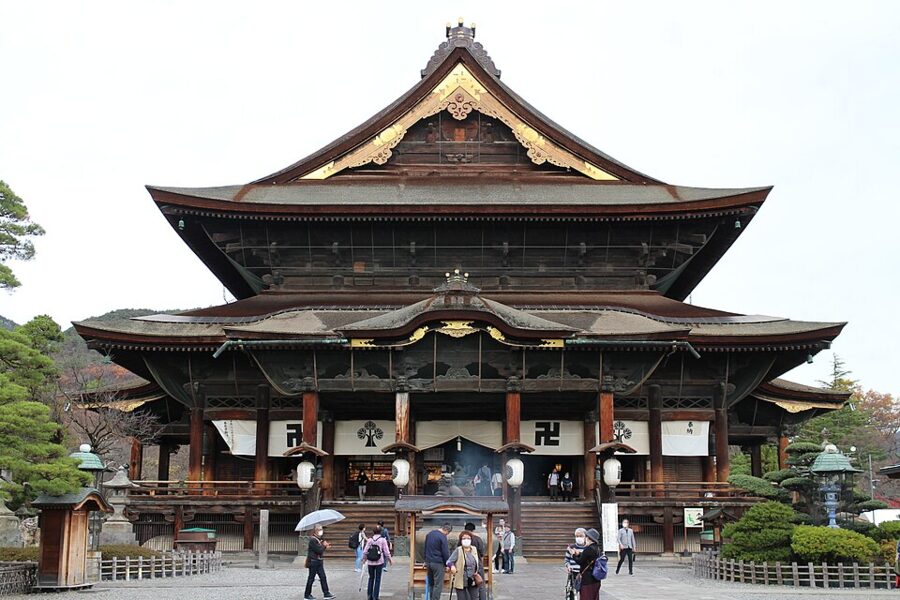
Back in Nagano, Zenko-ji (善光寺) is a 30-minute walk or a short bus ride from the station and the obvious thing to do with a spare hour before the train home. Obuse, a small town on the Nagaden line halfway to Yudanaka, has the Hokusai museum and chestnut sweets, and it is an easy stop on the way back.

Wildlife watching elsewhere in Japan
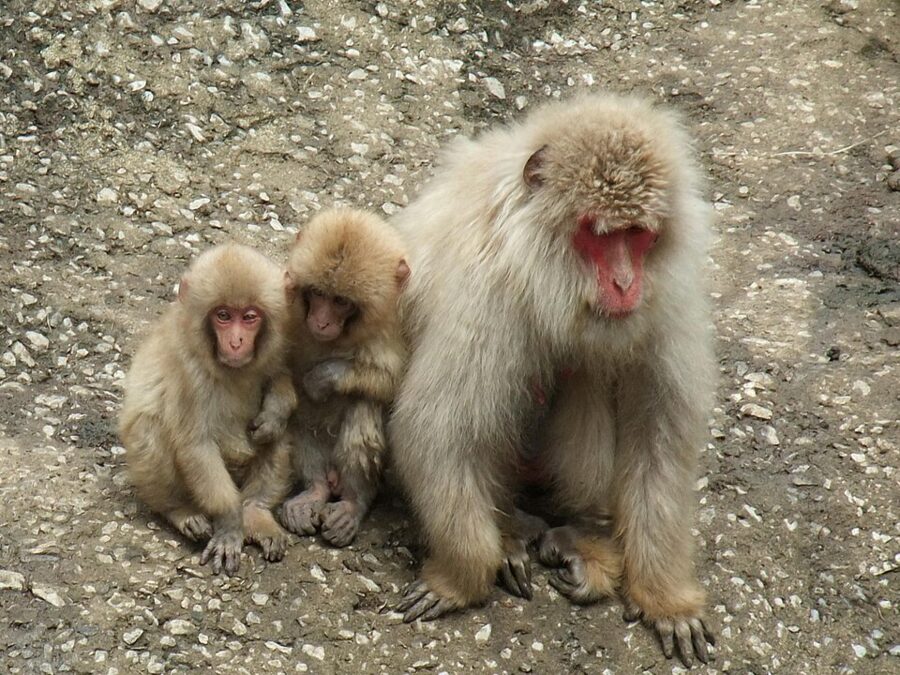
Japanese macaques live wild across most of the country, and you will see them on mountain roads and in hill towns without trying. The northernmost troops, on the Shimokita Peninsula in Aomori, are protected as a national natural monument and go down to the shore to eat seaweed and limpets, which no other macaques do on anything like that scale. On Yakushima the monkeys are a separate subspecies, the Yakushima macaque, smaller and stockier than its mainland cousins, with dark hands and feet.

For a winter wildlife trip, the obvious partner to Jigokudani is eastern Hokkaido. The red-crowned cranes of the Kushiro wetlands gather at winter feeding grounds at Tsurui and Akan from late autumn to early spring, dancing on the snow in pairs; Japan’s population is now put at around 1,850 birds. In summer, Hokkaido’s Shiretoko Peninsula has a dense population of brown bears, and the guide to bears in Japan covers how to see them and how to stay out of their way.
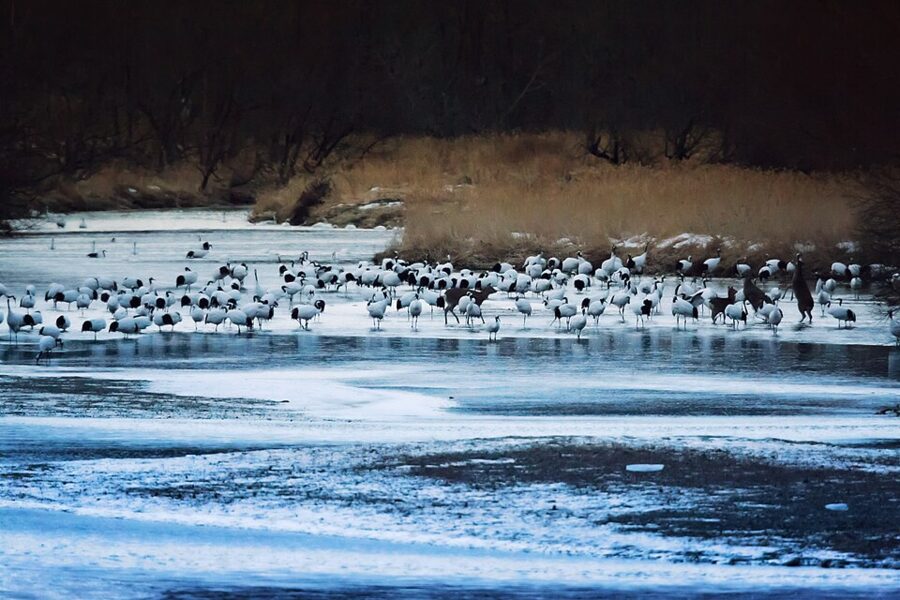

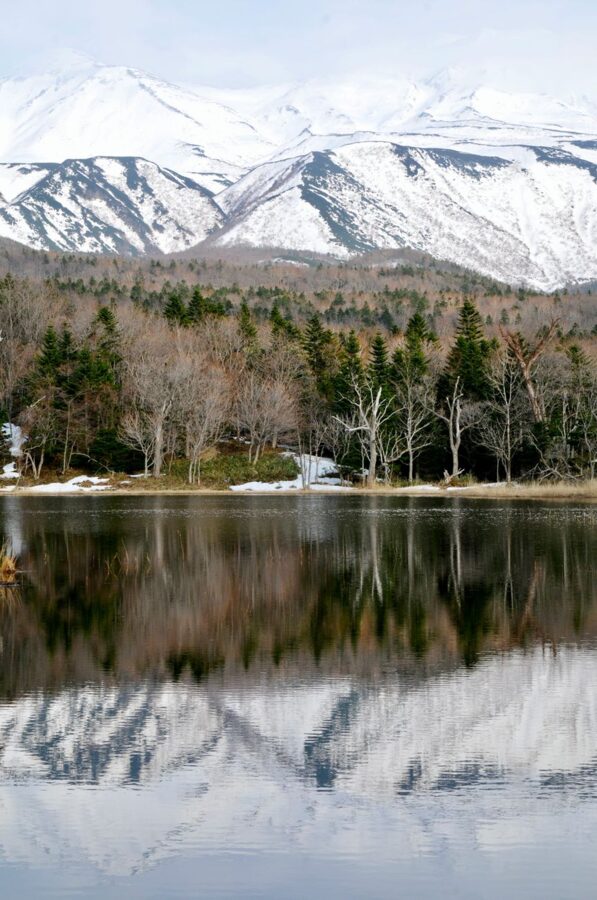
None of these is like Jigokudani. The cranes are seen across a field and the bears from a boat; nowhere else do you stand a few metres from wild animals that couldn’t care less.
So: buy the dated ticket before you leave home, and the bus pass too if you are coming from Nagano. Put the chain spikes in your bag in Nagano, not at the trailhead. And walk in early on a frozen weekday, on the ice that everyone else will polish smooth by 11:00.