
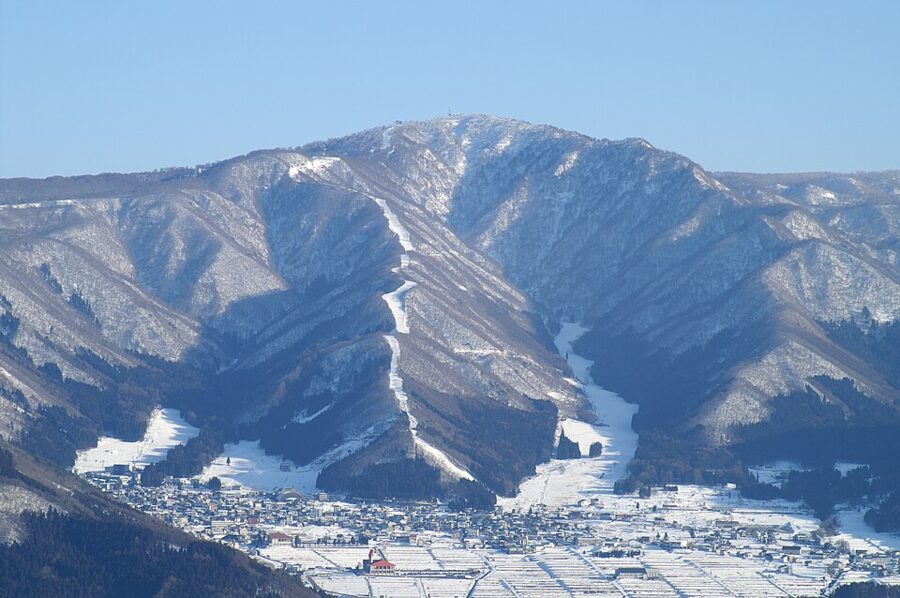

There are two doors in the boundary fence at the top of the Yamabiko quad, one either side of the lift station, and they are the only legal way off the Nozawa Onsen (野沢温泉) ski area. Pull one open and the sign on it tells you, in capitals, that this is your final decision point. Behind you is a patrolled resort with a gondola home. In front of you is the snow on Kenashiyama (毛無山), a village ordinance that bills you for your own rescue, and no avalanche bulletin written for this mountain.
Most people who come here never touch that door, and they still get a hard day. Of all the places for skiing in Japan, this is the one where the village matters as much as the mountain. The lifts climb from 565 m at the valley bottom to 1,650 m at the top, a vertical of about 1,085 m, and a run from the summit area to the village can stretch to around 10 km. At the bottom is a hot-spring village of steep lanes where thirteen bathhouses cost nothing to use, the source spring boils vegetables, and once a year the men of the village defend a timber shrine against a crowd with burning torches.
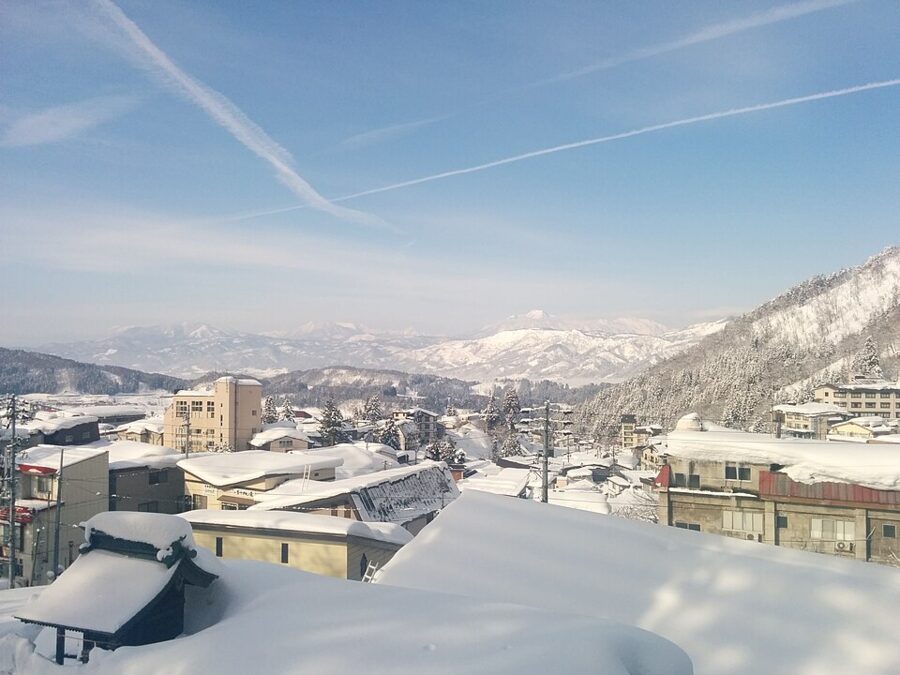
The snow is the reason the ski area exists and the water is the reason the village does. The Japan Meteorological Agency’s station in the village sits at 576 m and records a normal of 1,087 cm of snowfall a year, with 366 cm of it in January alone and a January mean of -1.6°C. That is wetter than Hokkaido at the bottom and very good at the top, which is the usual northern Nagano bargain.

Getting there is simple, which is part of why the village fills up. The Hokuriku Shinkansen runs from Tokyo to Iiyama in about 1 hour 45 minutes, and a ¥600 bus covers the last 25 minutes. Book the room before anything else: from late December to the end of January, and on the night of the fire festival, the village is full.

Contents8 sections
The village and its water
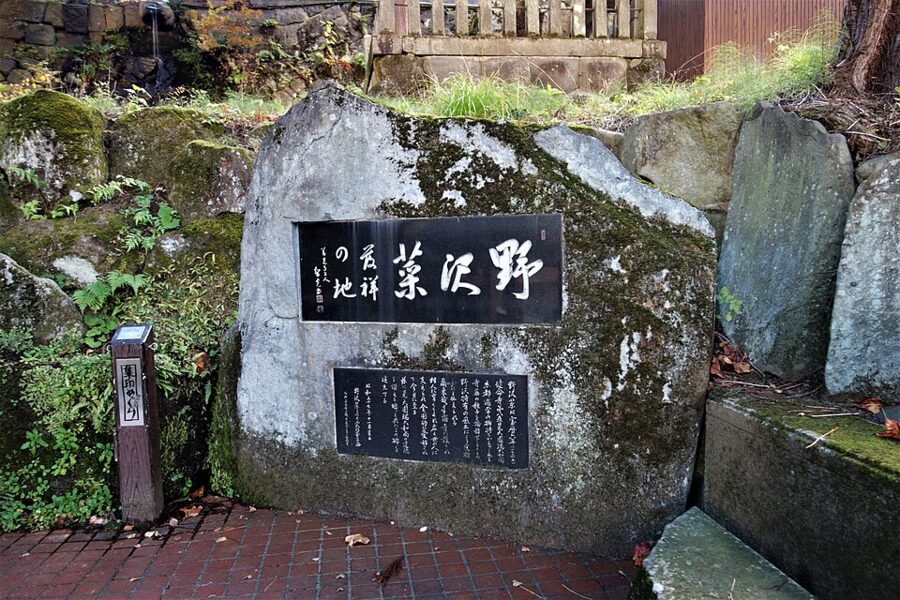
Nozawa Onsen is the only village in Japan with “onsen” in its name, and the springs are older than any record of it. Local tradition credits the monk Gyoki, some time between 724 and 748, with finding them; other versions give the credit to a wandering mountain ascetic or to a hunter following a wounded bear. The first written mention of the place, as Yuyama village, dates from 1272, and by the Edo period it had 24 inns serving people who came to soak away illness.
Today about 3,200 people live in the village, and more than 200 places to stay are packed into the streets around the baths. The springs rise on the flank of Kenashiyama, an old volcano that last erupted about a million years ago, and come out at anything from 40°C to 90°C. The village has more than 30 sources. They are not decorative: they are piped to bathhouses, laundries and kitchens, and the people who live here use them every day.
The thirteen soto-yu
The soto-yu (外湯, “outside baths”) are thirteen small public bathhouses scattered through the village, each fed by its own flow straight from the source with nothing added and nothing recirculated. Entry is free, with a wooden donation box by the door. From December to March they open 06:00–23:00, though Shinden-no-Yu and Taki-no-Yu shut at 21:00, and none of them has parking.
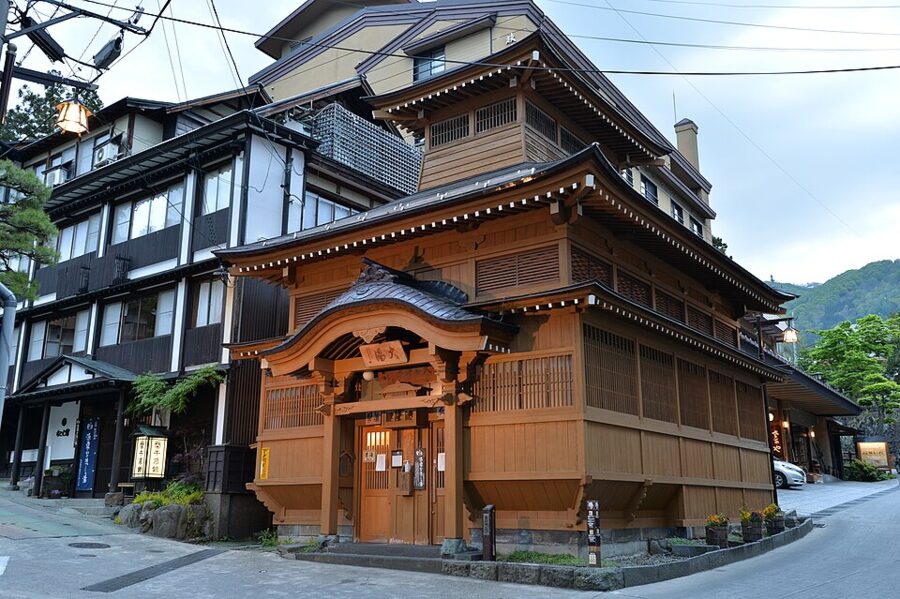

Inside, each bath is one room per sex: a raised changing area, a tiled floor and a single tub. There are no showers or washing taps, so you wash sitting on the floor, scooping water from the tub over yourself, and only then get in. Bring your own towel and soap, keep the towel out of the water, and leave swimwear at the inn.
The water in the tubs is typically 45–49°C. That is not a typo. Pour plenty over your shoulders before you commit, and if you need to add cold water, look at whoever else is in the bath first: some of them come for exactly that heat and will not thank you for cooling it. Locals come before work and after it, and the early morning soak is the best time to see the baths as they are meant to be used.
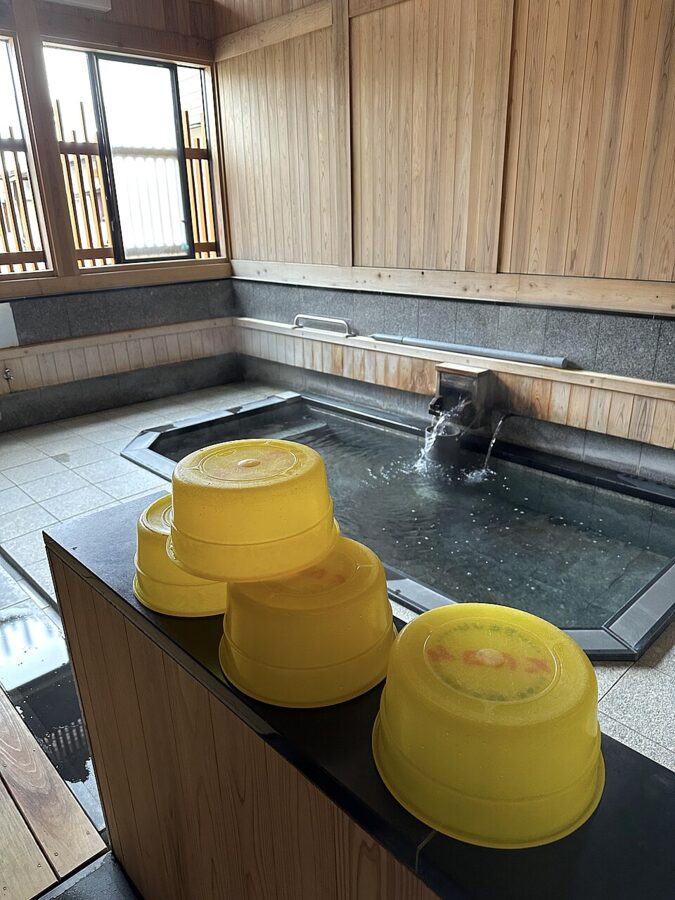

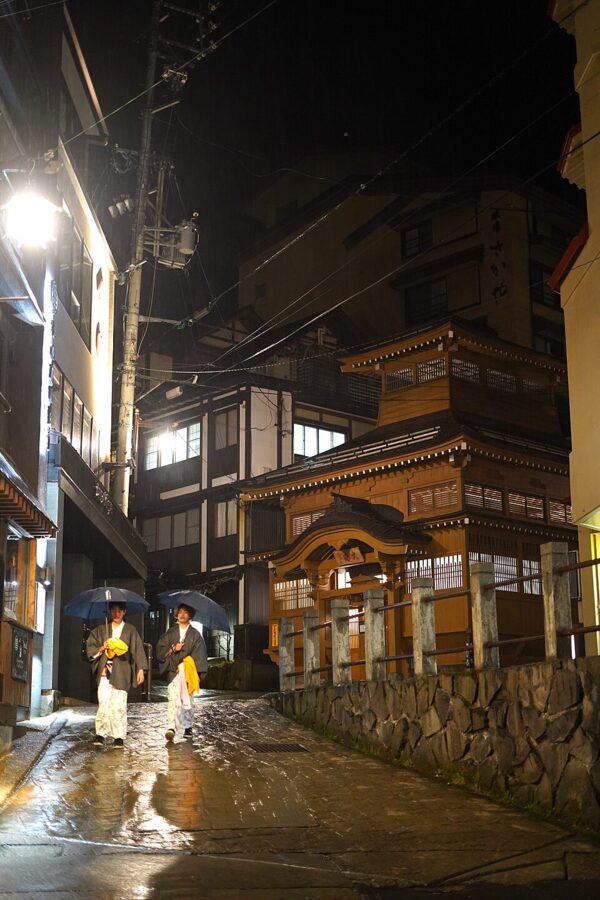

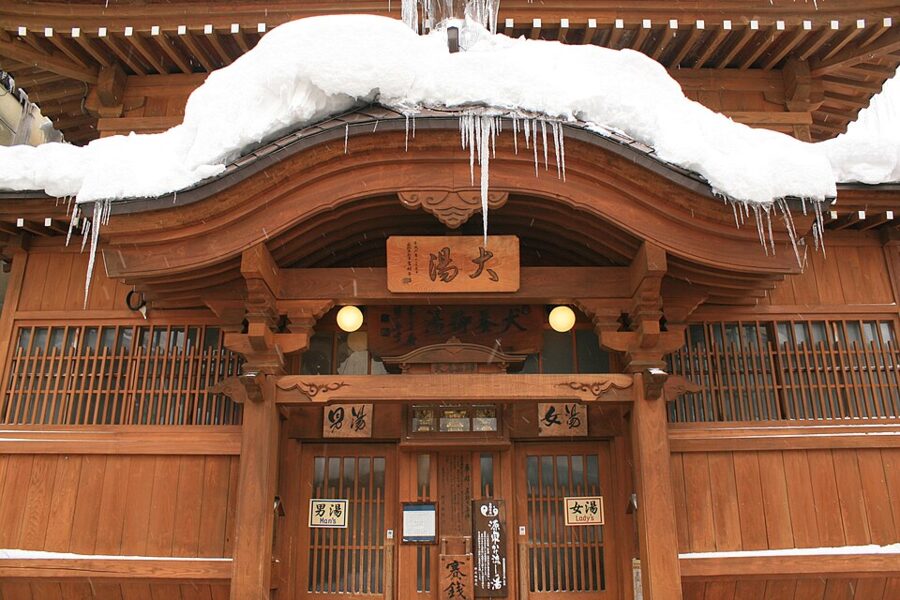
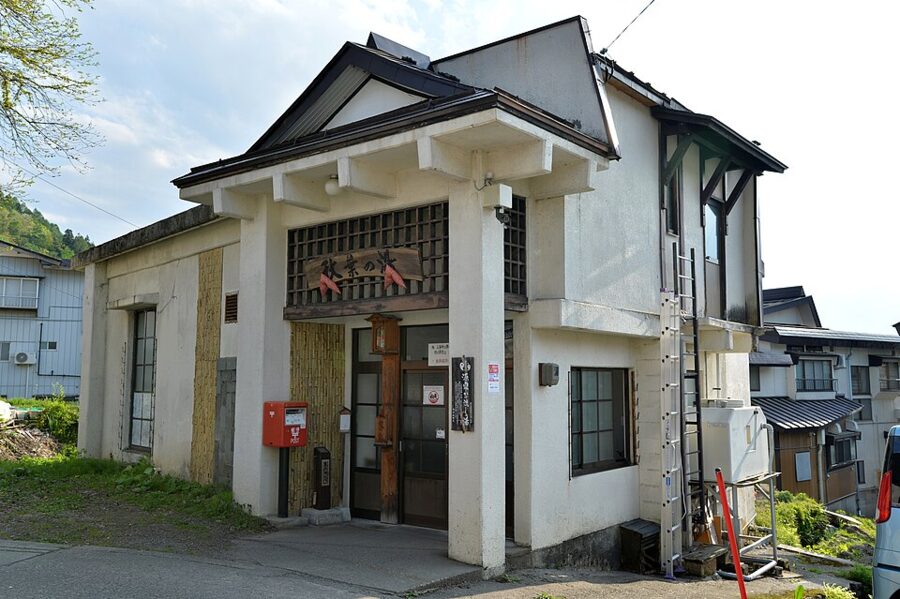
Oyu (大湯) is the one everyone photographs from outside. Nakao-no-Yu, up the hill, is the biggest wooden bathhouse of the lot and a good first bath because it is roomier. Kumanotearai-yu, “the bear’s hand-washing bath”, is the one the bear legend belongs to, and its water is the coolest source in the village. Juodo-no-Yu looks like a concrete block from outside and is one of the most popular inside: women on the ground floor next to the laundry, men upstairs.
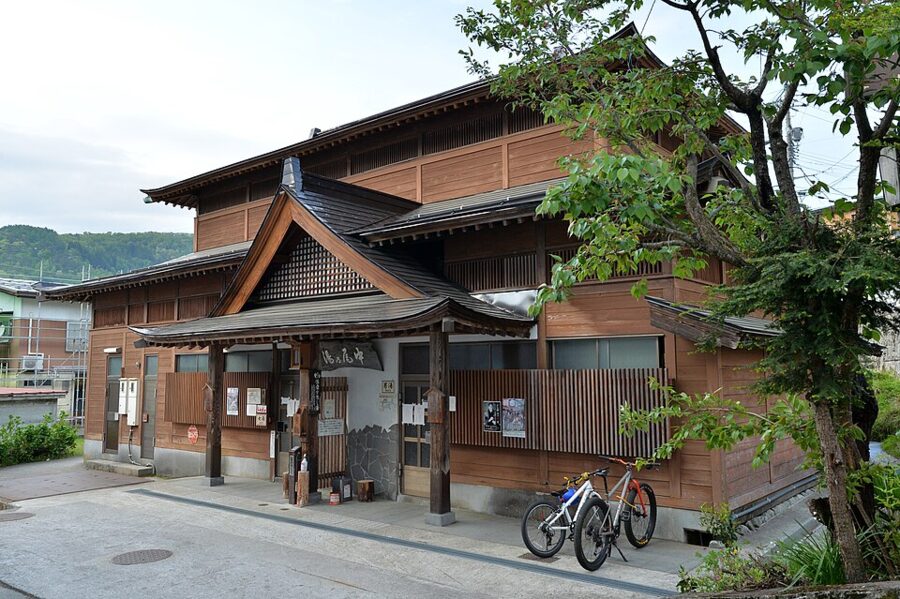

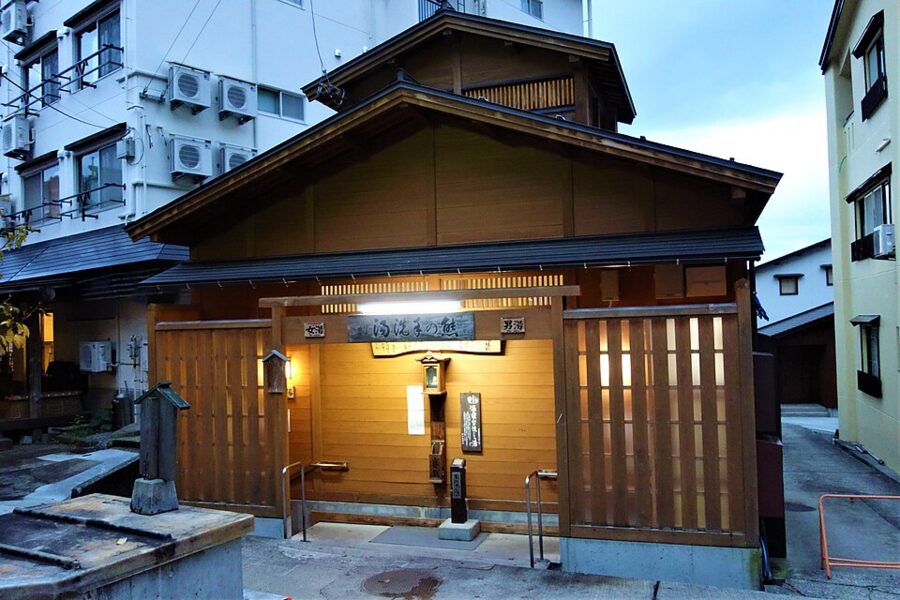

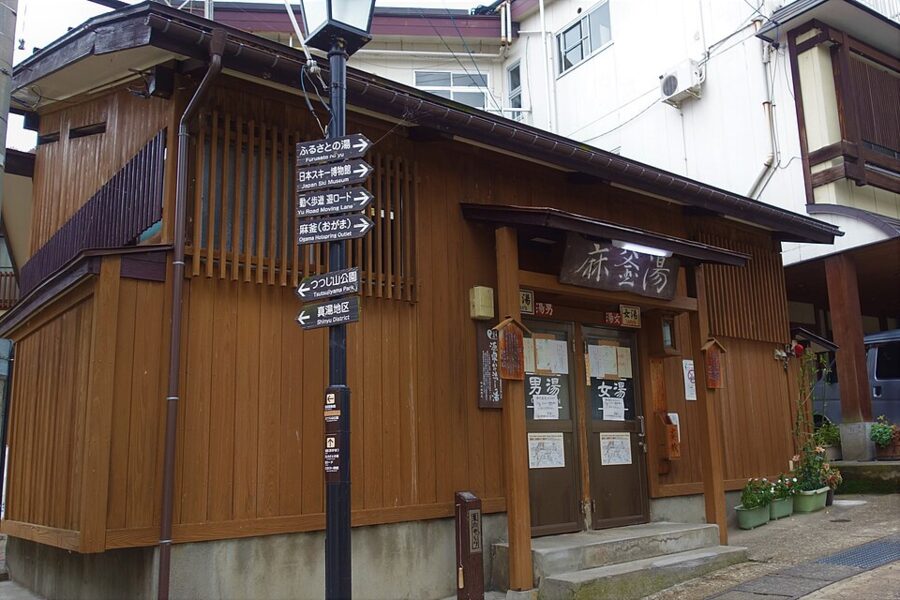
Six of the thirteen have a communal laundry pool next to the baths, and you will see villagers washing clothes or vegetables in hot spring water. Pick the right door. Matsuba-no-Yu has its laundry on the stone ground floor and the baths upstairs; Asagama-no-Yu, below Ogama, is tiny and has a laundry door beside the bath door.
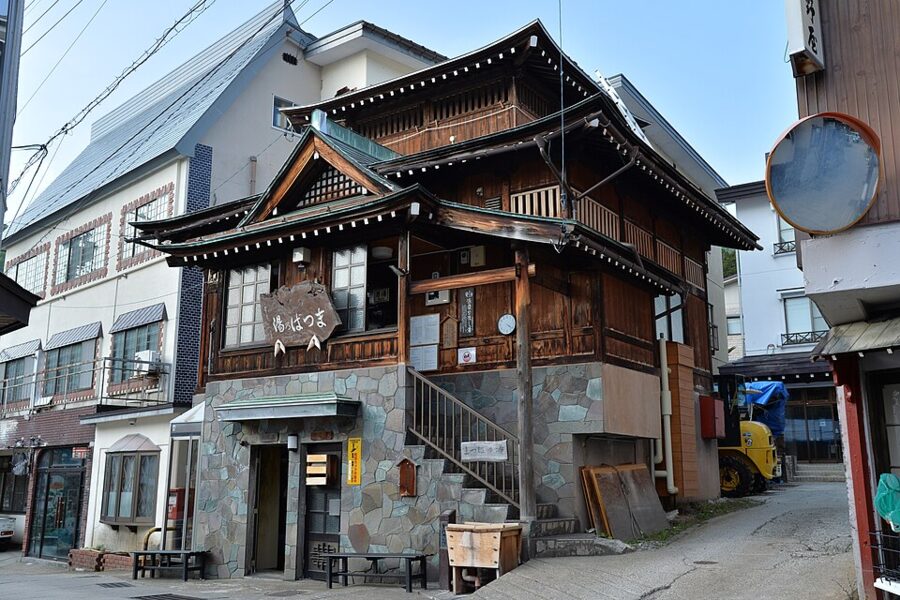

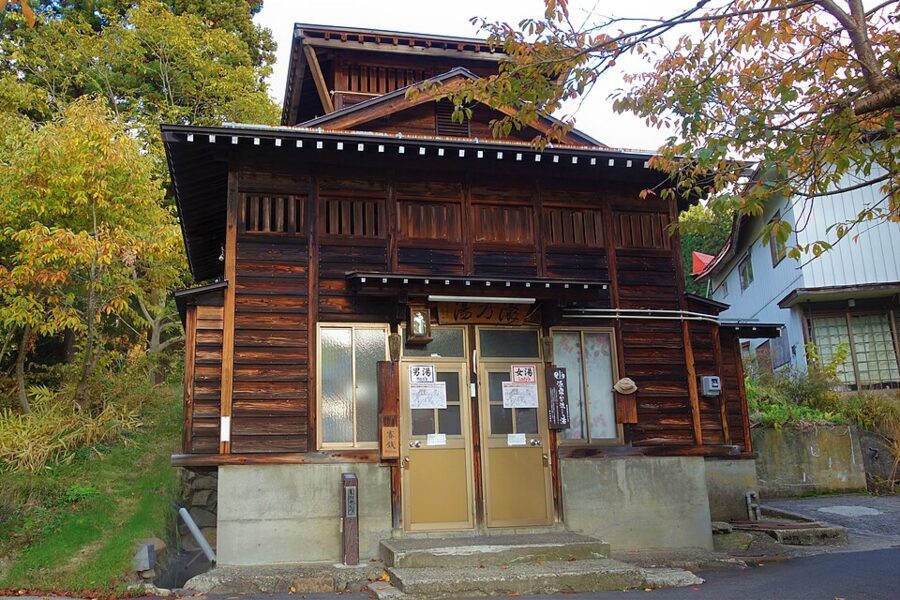

One bath has changed. Akiha-no-Yu, up the hill towards the ski area, closed for demolition work from 11 May 2026, with the closure planned to run to 30 October. During that time its stamp for the bathhouse stamp trail was kept at the tourist information centre. Ask there about its state before you set out to collect all thirteen.

Two rules that visitors break. The baths are the villagers’ property, not a tourist attraction, and the Nozawa Onsen Mountain Resort Tourism Bureau forbids filming or photographing for publication inside the soto-yu, at Ogama and at the festival rites without permission; inside a bath, the camera stays in your bag whoever you are. And a free bath is not a free-for-all: rinse before you get in, keep your voice down, and put a few coins in the box.
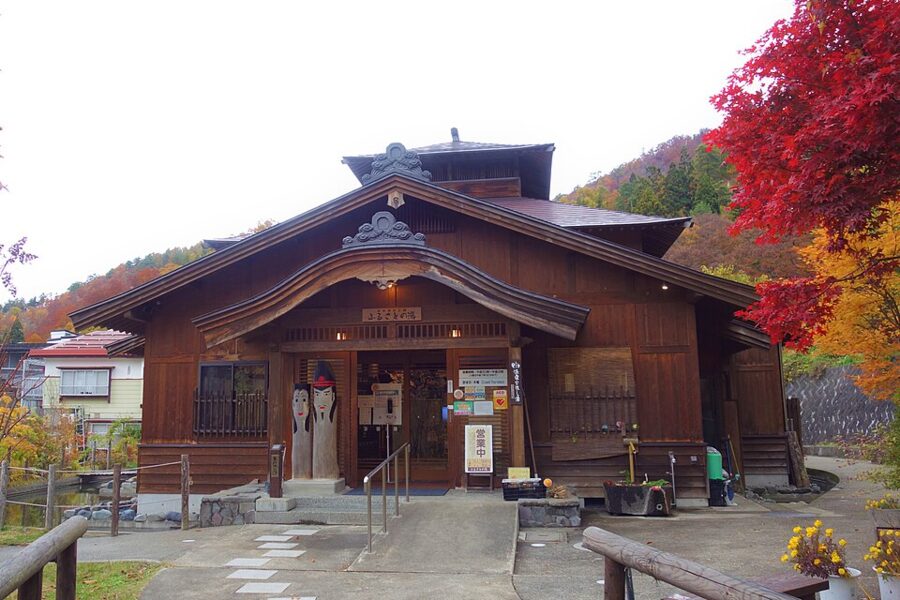
If the soto-yu are too much, there are two paid alternatives. Furusato no Yu, sometimes called the fourteenth soto-yu, has indoor and outdoor baths, showers and soap for ¥700 (closed Thursdays). Sparena, by the ski area, has swimwear baths for ¥900 and is where families with small children tend to end up.

Ogama, the village kitchen
Ogama (麻釜) is the main source, and it boils. Water close to 90°C comes up at about 500 litres a minute into five pools with names of their own: Ogama, Marugama, Yudegama, Takenoshigama and Shimogama. The name means “hemp cauldron”, from the days when hemp stalks were boiled here to strip the fibre, and the site is a village natural monument.
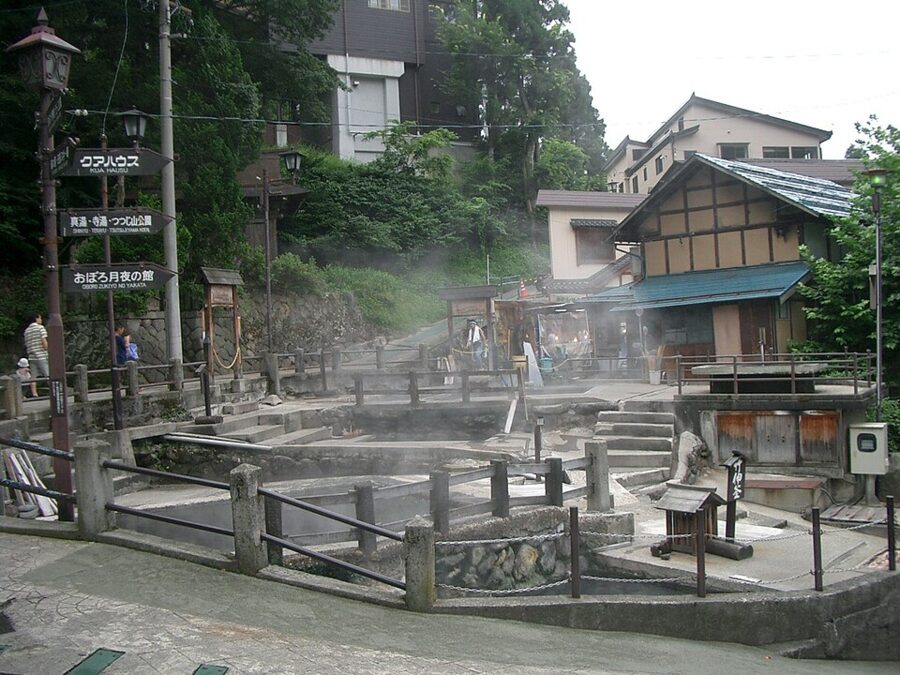

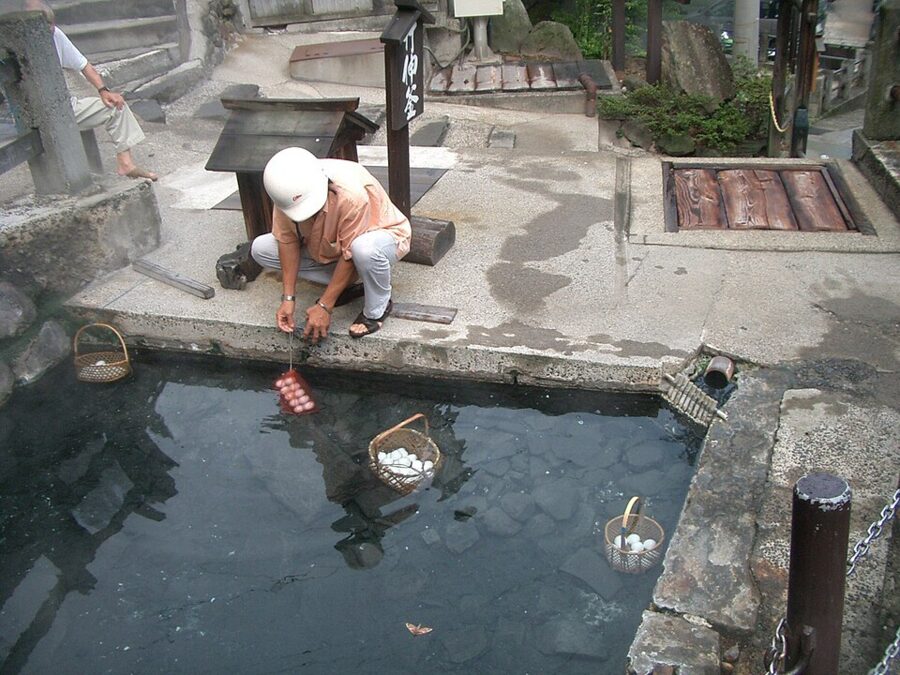
It is a working kitchen for the people who live next to it, who boil vegetables and eggs and swap gossip at the edge. Visitors are kept out, for the obvious reason. If you want hot spring eggs, bring your own eggs and a net bag to one of the egg-cooking spots and follow the times posted on the sign.


Nozawa-gumi and the yunakama
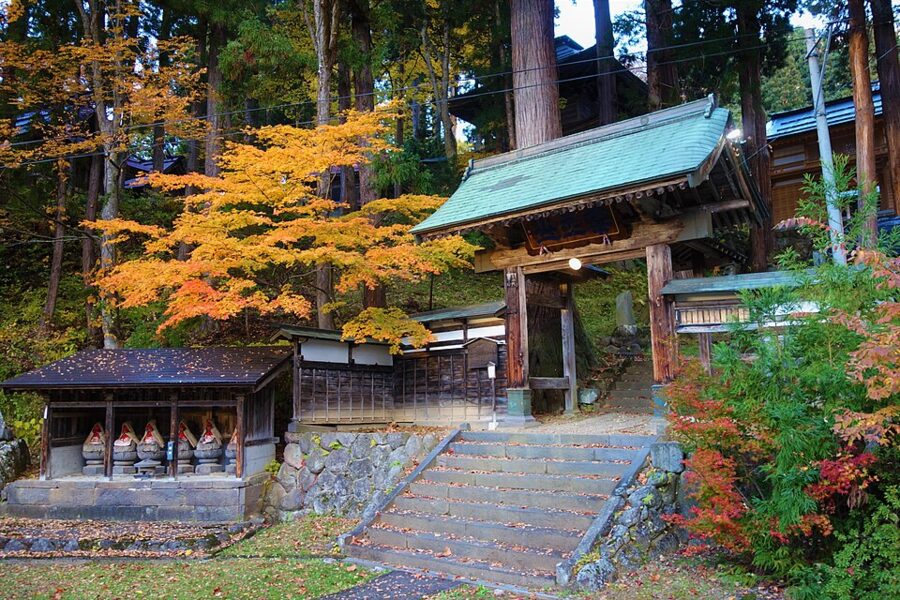
The baths are not run by the village office. Each soto-yu belongs to a yunakama (湯仲間, “bath fellowship”), a group of local households who have looked after it since the Edo period. Above them sits Nozawa-gumi (野沢組), a residents’ association dating from the late Edo period that owns and manages the village’s communal forests, water sources and hot springs.
Nozawa-gumi collects dues from residents and spends them on the springs, snow clearing and the irrigation channels, and it runs the fire festival. Its head, the soudai, has traditionally served a one-year term without pay. Some of the foreign residents who now run lodges and restaurants here have joined or pay dues, which tells you how the village decides who is local.
A century on skis
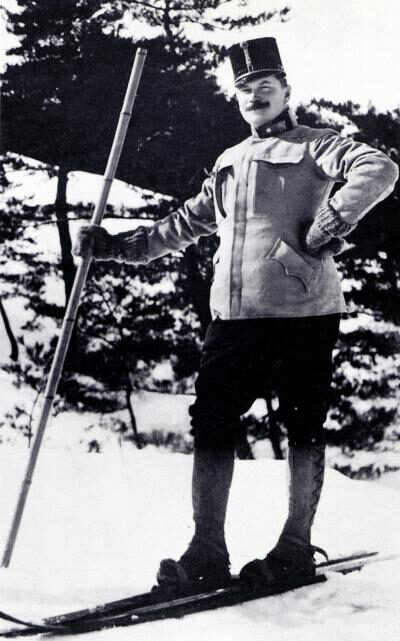
Skiing reached Nozawa in 1912. A teacher at Iiyama Middle School named Ichikawa and his colleagues went to the army regiment at Takada in Niigata to learn from Major Theodor von Lerch, the Austrian officer who brought ski technique to Japan, and came back to show the district how it was done. In 1923 the village founded the Nozawa Onsen Ski Club to turn snow into income, and in 1924 it persuaded the ski and mountaineering club of Hosei University to train here: the start of the ski area proper.
In 1930 the Austrian Hannes Schneider, the father of the Arlberg technique, came to Japan and taught and demonstrated at Nozawa. Nozawa’s best-known mogul run carries his name. A 50 m ski jump went up at Hikage in 1928, and in 1950 Hikage got the second chairlift at any civilian ski area in Japan, after Kusatsu, on wooden towers.
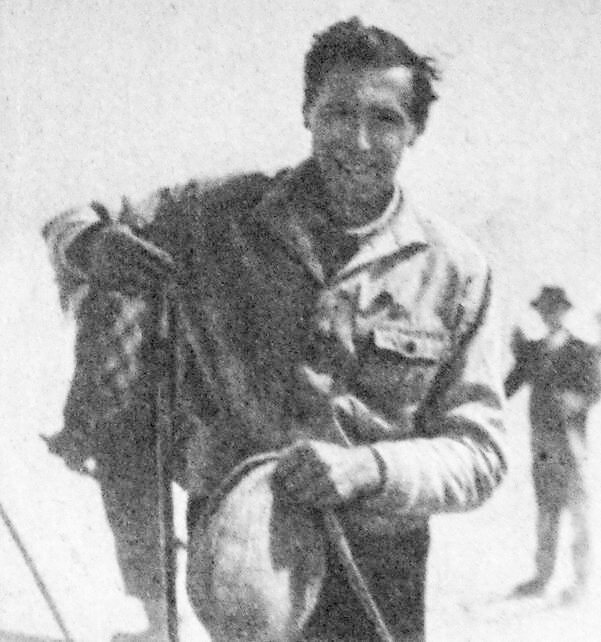
The rest is a list of things that happened because the snow was there. The ski area came under village management in 1963. In 1971 Nozawa twinned with St Anton in Austria, and in 1974 the artist Taro Okamoto designed the monument that stands beside a bronze of Schneider. Interski, the world congress of ski instructors, met here in 1995, and in 1998 the village hosted the biathlon at the Nagano Winter Olympics.
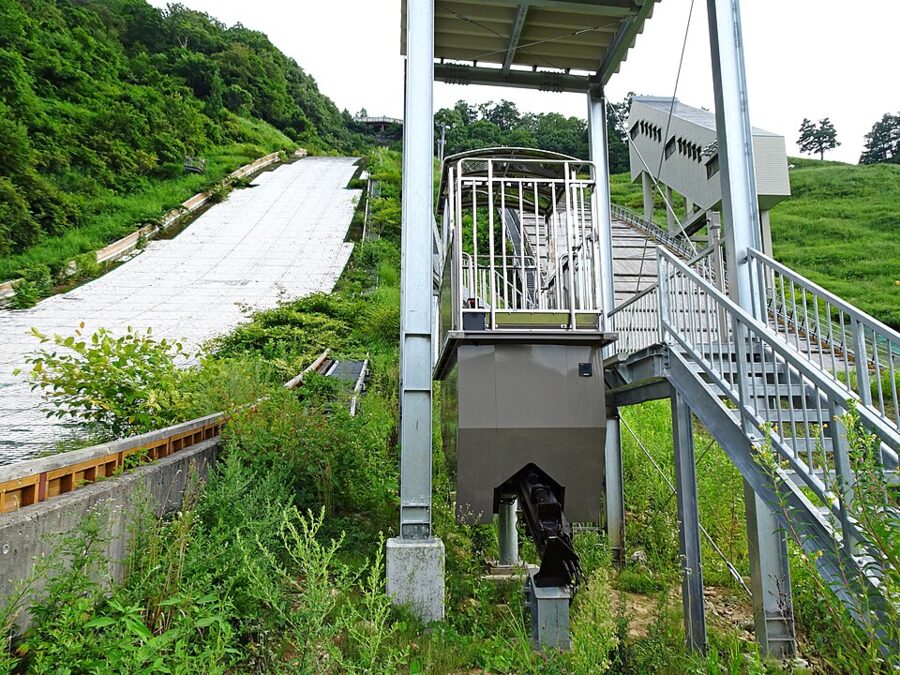

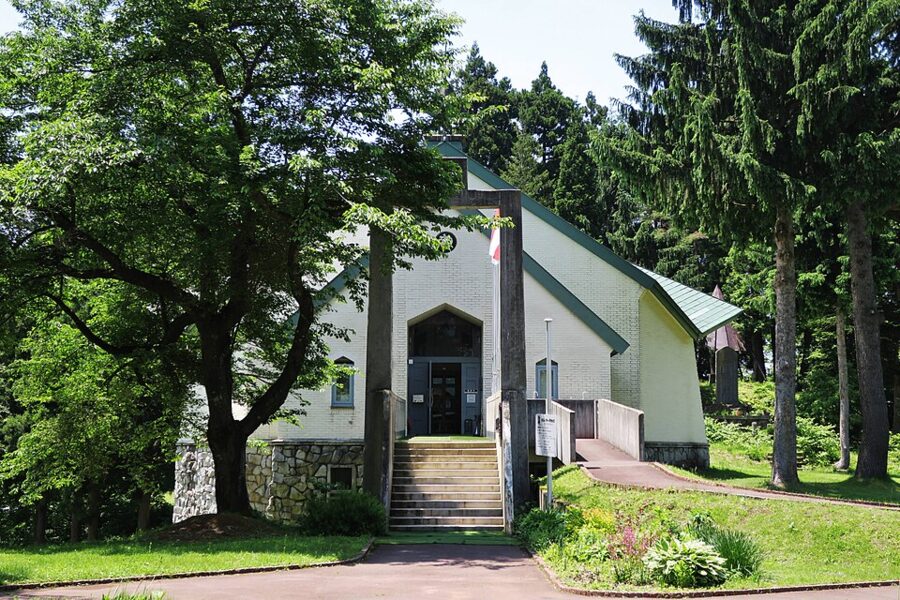
In 2005 the village handed the ski area to Nozawa Onsen Co., a company owned by villagers, as its designated manager, after years of falling numbers under direct village control. The ski club passed its centenary in 2023 and has produced sixteen Olympians, and the ski area marked a hundred years in 2024. The Japan Ski Museum at Isemiya, at the foot of the slopes, tells the story: open all year 09:00–16:00 except Thursdays, ¥300.

The ski area on Kenashiyama
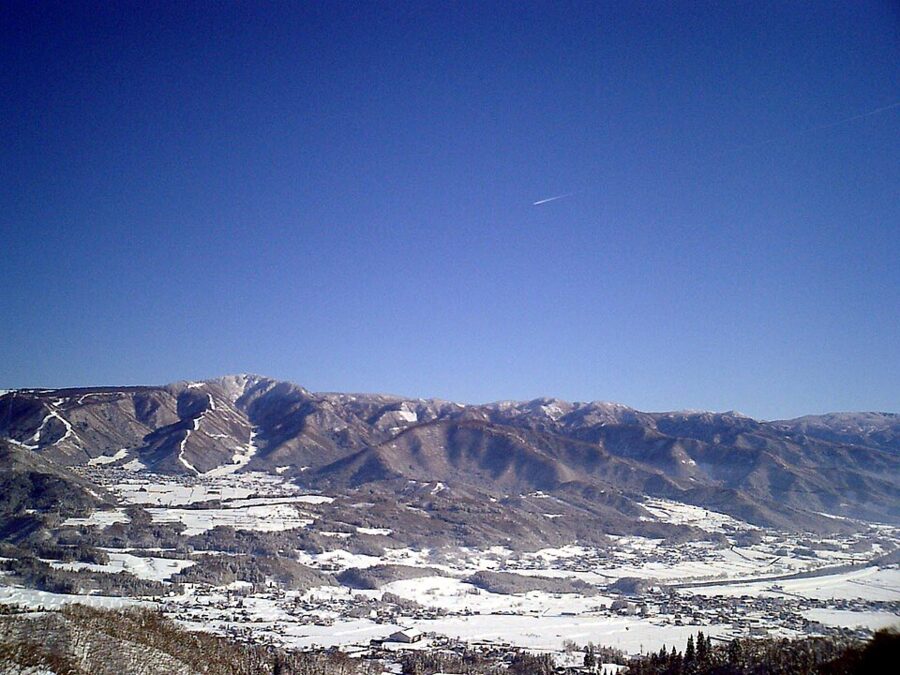
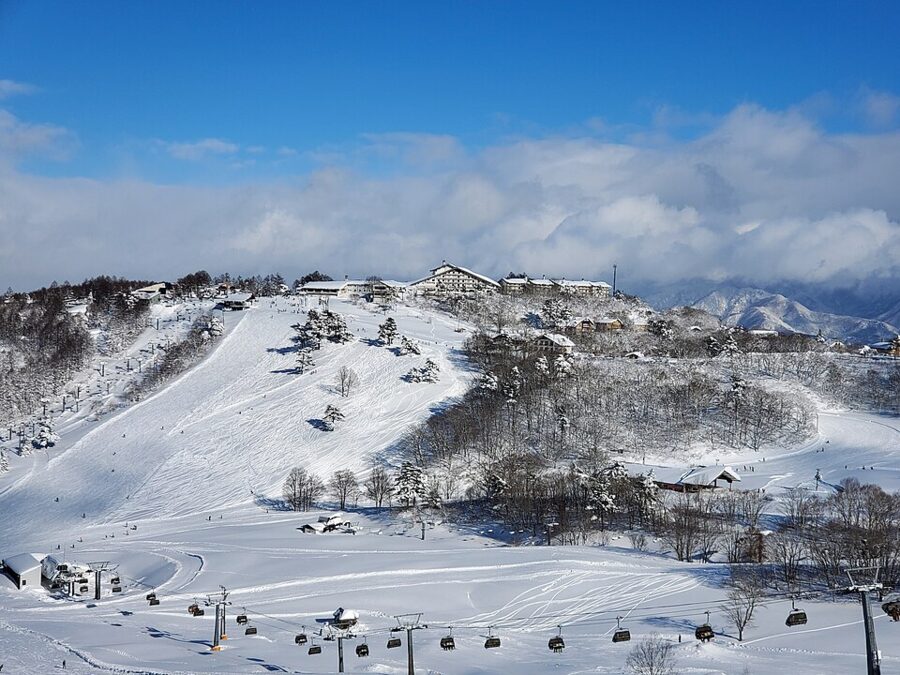
The mountain is a single long ridge that falls west from the 1,650 m summit of Kenashiyama to the Chikuma river. Maps give the summit as 1,649.8 m. The bottom lift station at Karasawa is at 565 m, so the lift-served vertical is about 1,085 m, and the classic top-to-bottom run, from Yamabiko down through Uenotaira, Paradise and the beginners’ forest trail to Hikage, is around 10 km long.
The lift system is big but uneven. There are two gondolas, the ten-seat Nagasaka and the six-seat Hikage, and a long list of chairs, some of which run only at weekends or not at all in a given season. In the main season the Nagasaka gondola runs 08:30–15:30 and the lifts at the bottom of the mountain until 16:30.
The number that matters is the Yamabiko quad’s last ride. If it has closed, there is no lift back from the top area to the lower mountain, and you ski down from wherever you are. The Yamabiko A to D runs close at 15:20 and Skyline at 16:10, so plan the day backwards from those times.
The Nagasaka gondola and the Yamabiko area
The Nagasaka gondola (長坂ゴンドラ) is the spine of the mountain. Rebuilt for the 2020–21 season, it runs straight from the Nagasaka base to Yamabiko station: 3,129 m long, 789 m of rise, ten-seat cabins and about eight minutes a ride. The old twelve-person standing gondola it replaced took around twenty minutes and stopped at a mid-station.
The queue at its bottom station is the first decision of a powder morning. The car park next to it, P1, holds 425 cars, and the overflow at P3 opens only once P1 and P2 are full. The lodges near Nagasaka are the ones to book if you want to be in the line before the lifts open. The ride down is free, which is useful in spring.
At the top, the Yamabiko (やまびこ) area is five runs, A to E, between about 1,366 m and 1,650 m, served by a covered quad to the summit and an open quad to the top of D and E. The resort says you can see the Sea of Japan from the summit on a clear day. It faces north, keeps the best snow on the mountain and can run into early May.
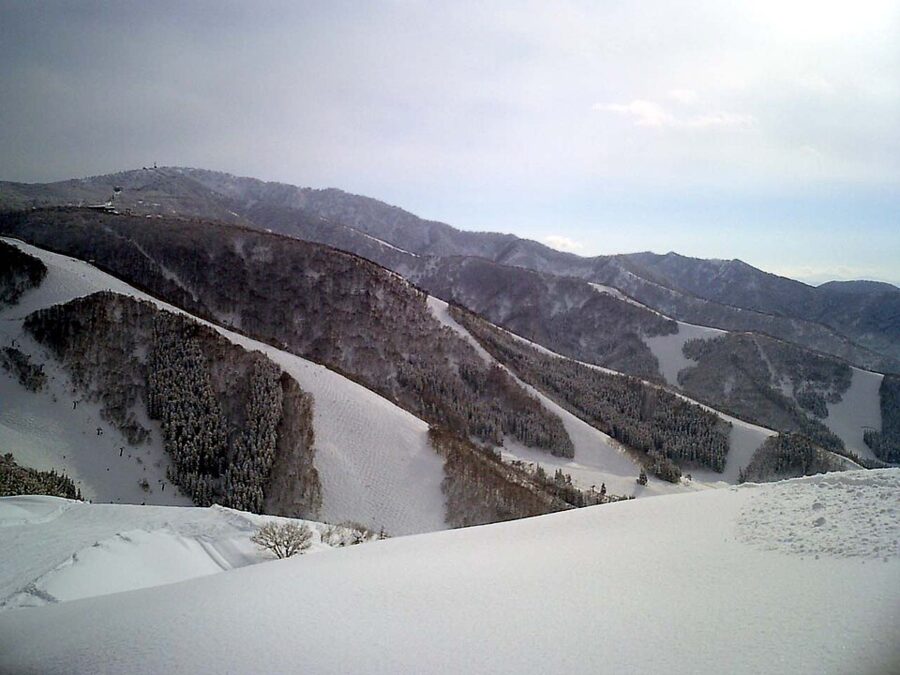

B course has ungroomed sections, and the open trees between the runs funnel back to the lift. Skiing them is at your own risk. On a storm day these trees are the reason the Yamabiko quad has a queue even on weekdays: the powder skiers have all done the same sums you have.
Skyline and the long way home
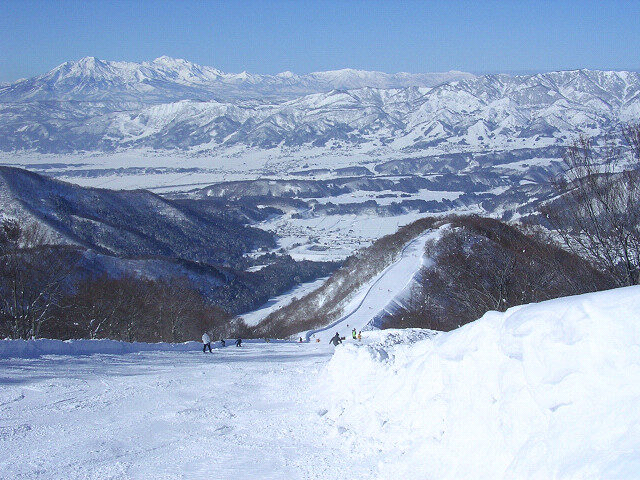
Skyline is the route that makes the vertical count. By the resort’s measure it drops 4.5 km along a ridge from the top of the gondola to the bottom of the mountain, and since the 2017–18 season you can drop into it straight from E course at the top of Yamabiko. The first 300 m is very narrow, so watch your speed around slower skiers.
Near the bottom four steep, ungroomed runs branch off it. Grand Prix and Jumping drop right towards the Nagasaka gondola and, being north-facing, hold good snow through the day; the resort’s own powder guide calls them some of the longest uninterrupted lines on the mountain. Hachiman and Mukobayashi, at the very bottom, face south and are best in the morning.

Schneider, Challenge and the moguls
Schneider is a 1.5 km ridge run from the bottom of Paradise down to Hikage, with a maximum gradient of 32 degrees. The top half is groomed daily. Halfway down it splits, and the steeper, ungroomed half becomes one of the fastest ways off the mountain and, in a dry spell, one of the bumpiest. It takes the sun, so ski it in the morning.
Utopia A branches right off Schneider and can turn into one of the biggest mogul fields at Nozawa, with powder on either side when it has snowed. Ushikubi (“cow’s neck”) runs down a ridge to the top of the Hikage triple and becomes one of the longest mogul runs on the mountain when snow is thin. Kurokura, next to it, is long and steep, and wind-scoured near the top.
Challenge 39° is the steepest run on the mountain: a 300 m face off the top of Schneider, sheltered from the sun and the wind. The resort warns that it can crack across the middle at its steepest point. The Challenge pair lift that serves the area runs only at weekends, over New Year and on holidays, so on a weekday you have to want it.
Where beginners go
Nozawa has a reputation as a steep mountain, but beginners get a lot of it. Uenotaira (上ノ平), a 2 km plateau run between 1,220 m and 1,410 m reached from either gondola, is wide, gentle and high enough for good snow, with the snow park down one side and a halfpipe at the bottom. Paradise, below it, is the biggest open slope on the mountain and lined with restaurants.
From Paradise the forest trail winds 5 km down to Hikage. It is narrow, only 7–10 m wide in places, and a short cut near the bottom splits groups, so agree where to meet. Its entrance closes at 15:50. If you are not confident, ride the gondola down instead; nobody will judge you, and the descent is free.
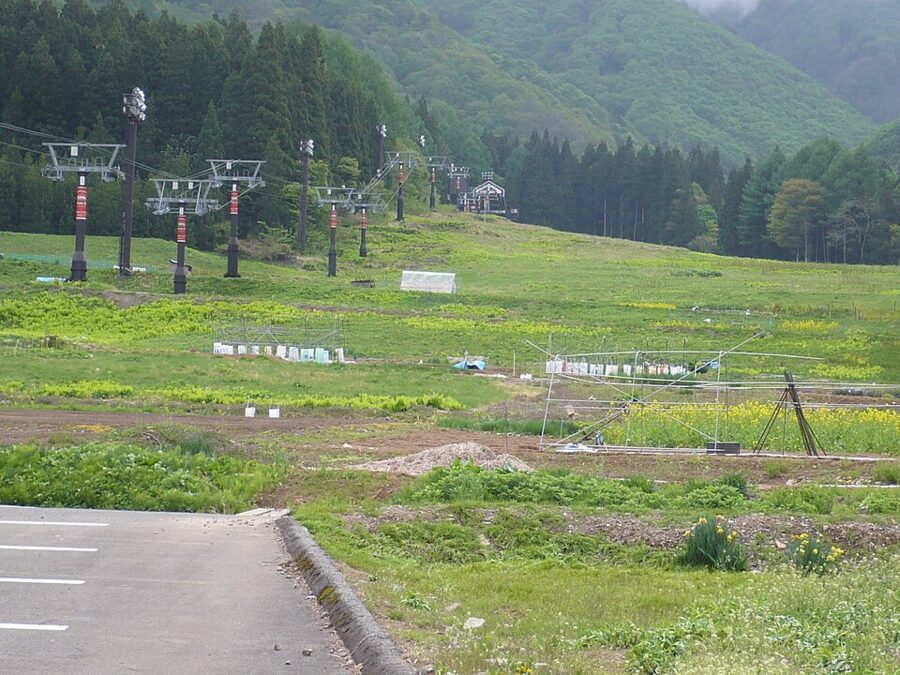

The bottom of the mountain has three separate learning areas. Hikage, the heart of the old ski area, has the ski school, the kids’ park and a free moving walkway, the Yu Road, that runs up from the village between Yuzawa Shrine and Ogama, 08:00–16:40. Nagasaka has rental shops and the gondola. Karasawa, by car park P2, is 3 km long at an average of only 8 degrees, the gentlest long run on the mountain.
Season, lifts and tickets for 2026–27
The 2026–27 season runs from 28 November 2026 to 5 May 2027, with the opening festivities on 19 December. Regular-season prices apply from 19 December 2026 to 28 March 2027: a one-day ticket is ¥7,800 for adults, ¥4,700 for children under 15 and ¥6,300 for seniors over 60. Two days cost ¥14,500 and three days ¥21,200, used on consecutive days, and a four-hour ticket is ¥6,700.
Outside the regular season it is cheaper. During the early-season period to 18 December a day is ¥5,600, and in the spring season from 29 March to 5 May it is ¥6,100. From 29 March the descent courses close, Skyline, the forest trail and everything below Paradise, so in spring you ride the gondola down. Pre-school children ski free with a paying adult, one child per adult.
Night skiing is on the Nagasaka quad, 16:30–20:00, and only on certain dates: nightly from 26 December 2026 to 2 January 2027, then Saturdays from 9 January to 20 March, plus 10 January and 21 March. The night ticket is ¥2,850. On New Year’s Eve the Nagasaka slope stays open until 23:30 for the countdown and fireworks.
Non-skiers can ride the Nagasaka gondola up and down for ¥3,750 in winter. If you are staying at an inn that belongs to the tourism bureau, ask about its discounted lift tickets for overnight guests, valid from 19 December to 28 March; not every inn sells them.
The backcountry
Behind the two doors at the top of the Yamabiko quad is a mountain that nobody manages for you. The resort’s backcountry notice places them at the top of the Yamabiko A course, left of the lift station, and at the top of D course to its right. They are the only permitted exits. Ducking the rope anywhere else is banned, and when snow is thin the doors are not set up at all.
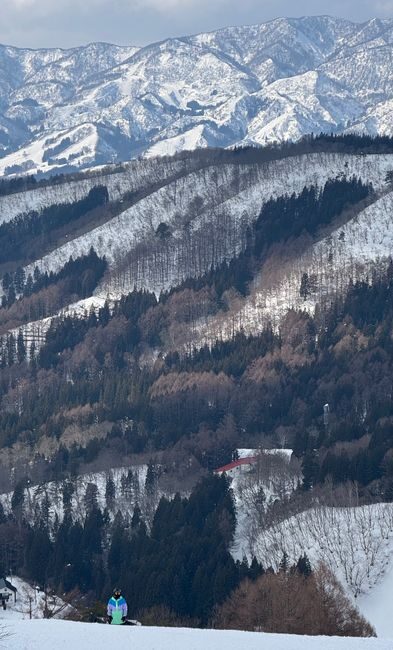
Close the door behind you so that nobody follows you out by mistake. Beyond it there is no avalanche control, no patrol and no rescue from the ski area if something goes wrong. Once the lifts have closed you are not allowed back into the controlled area, so a late exit means committing to whatever line you have chosen.
The legal stick is the village’s ski area safety ordinance, in force since 1 December 2010. Article 11 says that a skier who is searched for or rescued after an accident outside the designated ski area must repay the cost to the ski area’s operator. The ordinance sets no figure. The resort’s warning is that the bill can be very large and that in some conditions a search may not be possible at all.
You do not need permission to leave the boundary, and the resort says so plainly. What it asks is that you file an entry report, a climbing notification (登山届) for the day. Download the form from the resort, or file through the Compass online system, and hand a copy to the patrol station or the Nagasaka information centre.
It is not a permit. It tells rescuers where to start looking, and its value is entirely in the hours it saves.
Take the kit the resort lists in its backcountry users’ guide: beacon, shovel, probe, spare warm layers, food for longer than you plan to be out, a headlamp, a lighter and a fully charged phone with a spare battery. Do not go alone, and descend one at a time on anything steep. If the weather turns or someone in the group is struggling, the tour ends there.
Know what you will not get. The Japan Avalanche Network publishes daily avalanche bulletins for Hakuba, Myoko, Kagura and a few other areas, but none for Kenashiyama. Myoko, across the border in Niigata, is the nearest. You are reading the snow yourself, from the weather, the last few days of loading and what you dig.
The resort’s warning to backcountry users opens with 2023: a season of accidents and avalanches it blames on poor preparation, ending in three deaths. Most calls for help come in the late afternoon and evening, when tired groups run out of light. Since the 2024–25 winter the ski area company has used drones with thermal cameras to search at night.
If you do not know the terrain, hire a guide. The Nozawa Onsen Ski School, whose international side is run by Canyons, lists guided backcountry tours on its current page at ¥30,000 a person for a group of two to six, or ¥120,000 for a private group of four. Touring skis or a splitboard are strongly recommended over snowshoes, and the school reckons on 10–20 minutes of climbing for every minute of skiing. That ratio tells you what kind of day it is.
The Dosojin fire festival
On the night of 15 January, the 25-year-old and 42-year-old men of Nozawa stand on and around a timber shrine and fight off the rest of the village, who are trying to set fire to it with torches. The Dosojin Matsuri (道祖神祭り) has run for more than 300 years. It is an Important Intangible Folk Cultural Property and is often listed as one of Japan’s three great fire festivals.
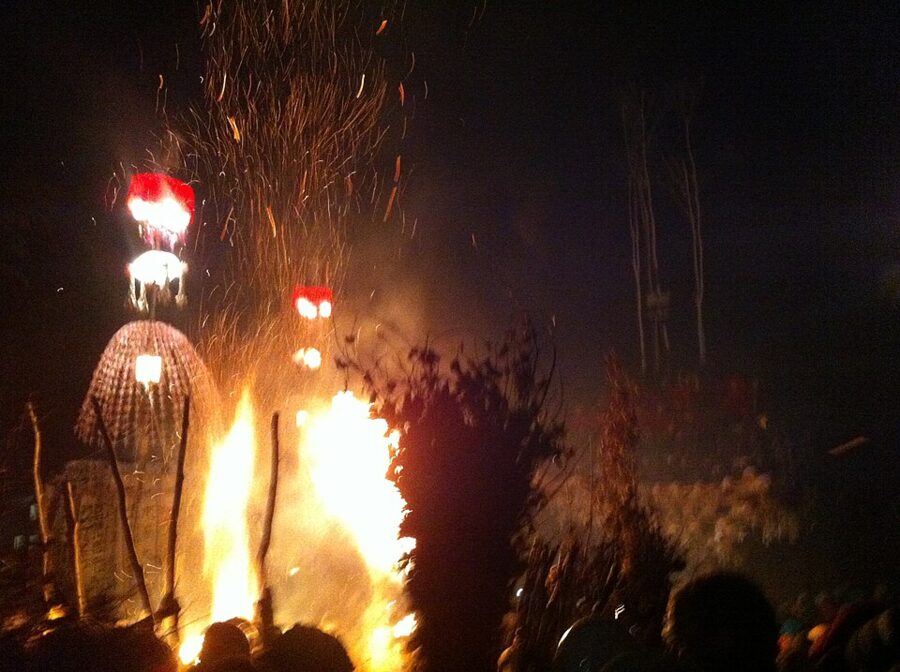

Dosojin are the folk gods of village boundaries and crossroads, who keep out disaster. In Nozawa they appear as a man and a woman, and people pray to them for a good marriage, children and healthy growth. The festival is run by Nozawa-gumi, and the hard work falls on the men in their yakudoshi, their unlucky years. Carrying it out is how a man is accepted as a full adult in the village.
It starts months earlier. In mid-October the yakudoshi men fell five straight beech trees from the village forest, after prayers to the mountain god. The 2026 felling was on 10 October, with a free guided tour for 40 people. Sources give the trees as about 18–20 m long and 30–40 cm across.
On 13 January two of those trunks are hauled by hand from the Hikage slope through the village to the festival ground, a job of about three hours with sake offered from the houses along the way. It starts with a race between the 25s and the 42s on the slope. On the 14th the men begin building the shaden, the shrine structure, without nails or wire and without alcohol once work has begun. It is finished around midday on the 15th, about seven metres high and eight metres square, with the sacred trees standing well above it.
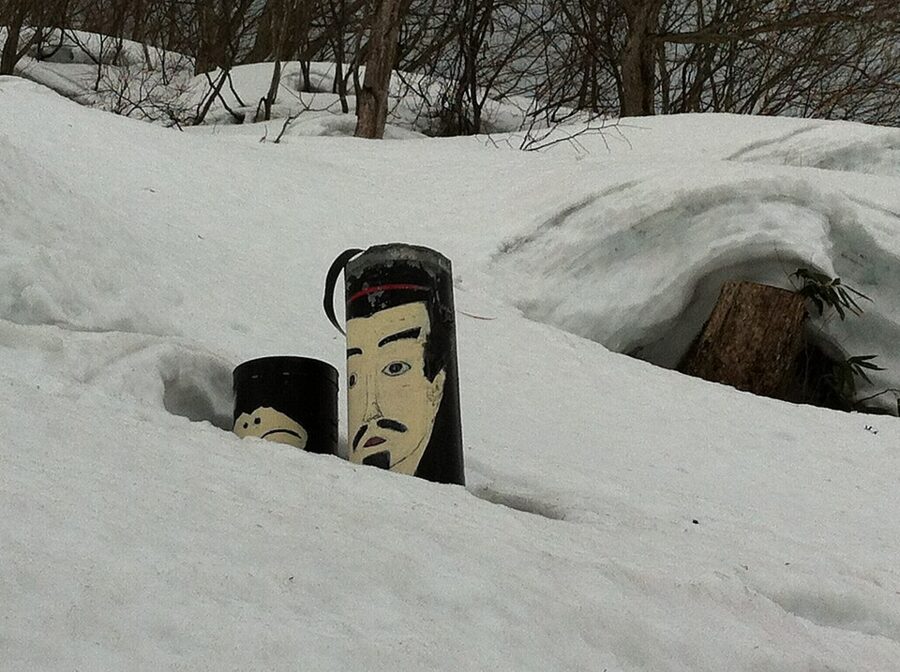

In the evening the families with first-born babies carry their hatsu-toro lanterns through the streets to the site, singing Dosojin songs. Then the himoto, the source fire, arrives and lights a pile of brushwood about 30 m from the shaden. The 42-year-olds take their places on top of the structure and the 25-year-olds stand below to defend it.
The first attack comes from the head of Nozawa-gumi, then the lantern families, then the village children, and only then the adults. For about an hour and a half the villagers drive at the shaden with burning bundles while the young men beat the flames out. It ends with tejime, the ceremonial hand-clap, the men climb down, and the fire is set deliberately inside. The lanterns go into the blaze one by one.
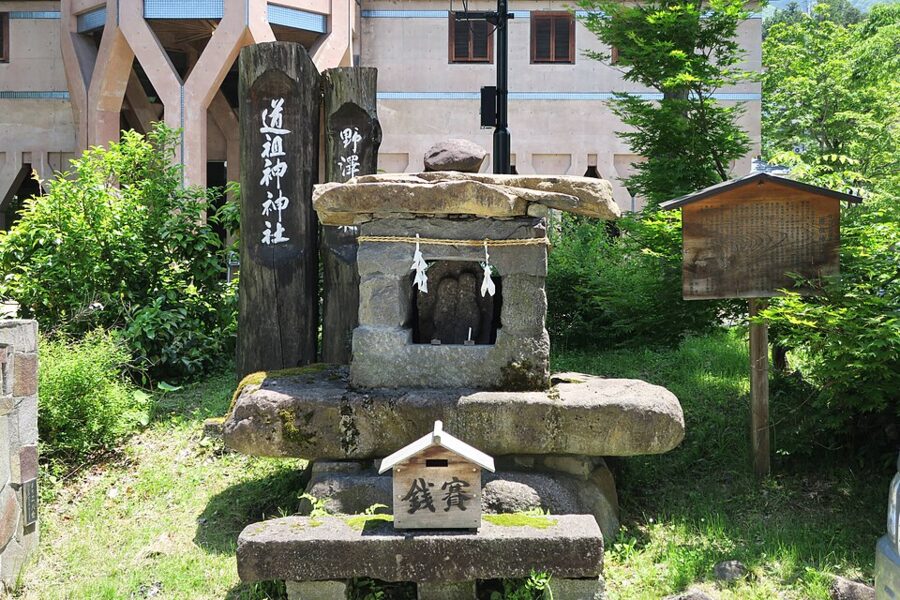

Here is the part that has changed. For 2027, with 15 January falling on a Friday, access to the fire ceremony on the night of the 15th is restricted to village residents and guests staying overnight in village accommodation, and an admission ticket is needed to enter. The site is a gentle snow slope that gets packed, so numbers are capped.
The tree-hauling on the 13th, the building on the 14th and the daytime on the 15th are open to anyone. If the fire is the point, book a room in the village first and ask the inn how its guests get tickets. Then dress for standing still on snow for hours in mid-January: insulated boots, a hat you do not mind getting sparks on, and nothing synthetic you love.
Eating and staying
The local food is a pickle. Nozawana (野沢菜) is a turnip green with long stalks, salted in tubs in late autumn and eaten all over Nagano. The village story is that around 1756 the eighth abbot of Kenmeiji (健命寺), the temple at the north end of the village, brought back turnip seed from Kyoto, and that in the cold and snow it grew into something new. Genetic study of the seed has since cast doubt on the Kyoto turnip part of the story, but the temple still produces the seed.
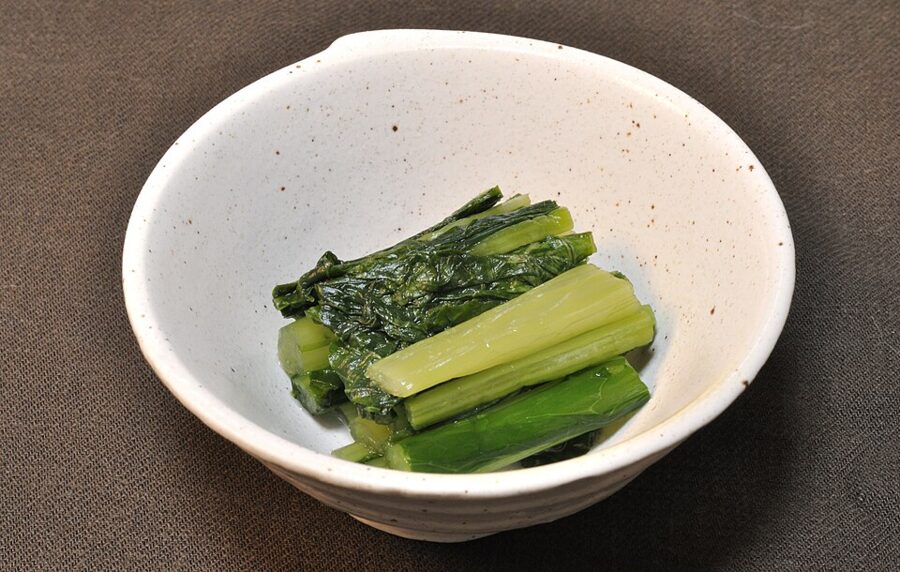
In late October and November the village washes the harvest in hot spring water at the laundry pools beside the baths, a scene the locals call o-na-arai. The tourism bureau says hot water gets the insects off and makes a better pickle. By the start of the ski season the first batches are ready, and a dish of it often arrives at the table before you have ordered.


Other local food is seasonal and filling. In spring the village makes a miso soup of bamboo shoots and mackerel. Shops along the lanes sell onsen manju, steamed buns from ¥70 each, and the cold soft water from the beech forest goes into local sake, craft beer and gin. In winter the restaurants get busy between about 18:00 and 21:00, so book a table when you can.
More than 200 places to stay share the village, nearly all of them small. There are no big resort hotels; instead there are ryokan, family minshuku, pensions and, increasingly, lodges and apartments. Through the 2010s foreign owners, many of them Australian, took over closed inns and opened restaurants, and they now account for 50–60 businesses, somewhere between a tenth and a fifth of the village’s total.
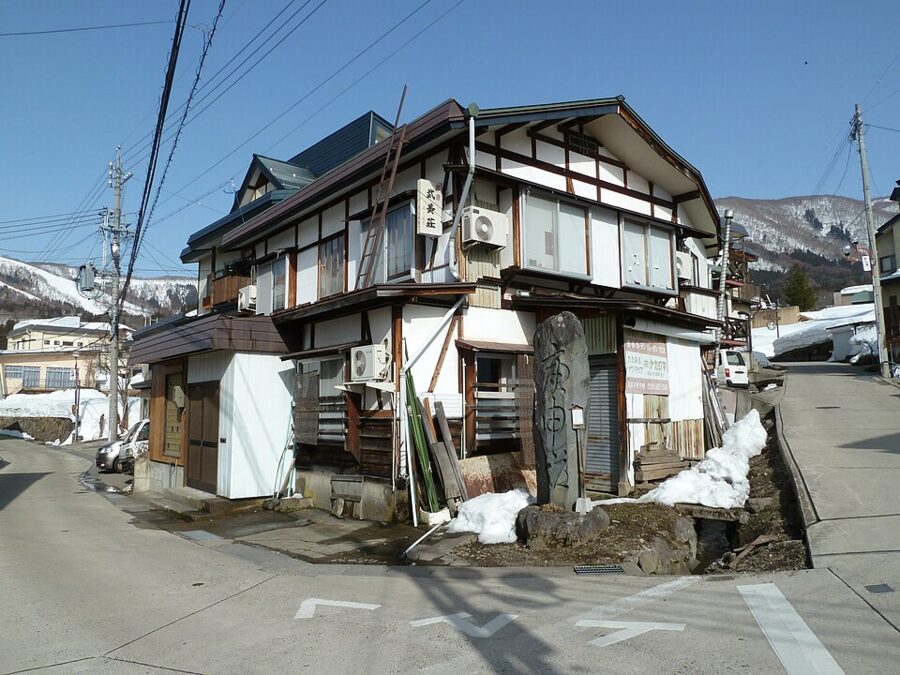

A few names that are open for the 2026–27 winter. Kawaichiya Ryokan, a traditional inn, was posting new plans in October 2026.
Lodge Denbey sits right on the slopes in the Utopia and Isemiya area and is taking winter bookings for stays of two nights or more. Stay Nozawa, which runs the Schneider Hotel and Kamoshika Ski Lodge among others, has opened bookings for the season. The tourism bureau also runs an inquiry form and will try to place you if you are stuck.
Rooms go first for the weeks from Christmas to the end of January, and January is the snowiest month. February is busy, and the night of 15 January is booked solid long in advance. March is quieter, the days are warmer and the upper mountain still has snow, and from 29 March lift tickets drop to the spring price.
Bring cash. Many restaurants do not take cards, and cash machines are few: the resort’s 2027 village map marks them at the post office and at L’atelier KURA by the tourist information centre, and flags another that does not take foreign-issued cards. Lift tickets can go on a card.
Getting there
The nearest station is Iiyama (飯山駅) on the Hokuriku Shinkansen, about 1 hour 45 minutes from Tokyo on a direct train and 11 minutes from Nagano. From the Tokyo airports, take the train to Tokyo Station and change there. Book the shinkansen ahead at peak times.
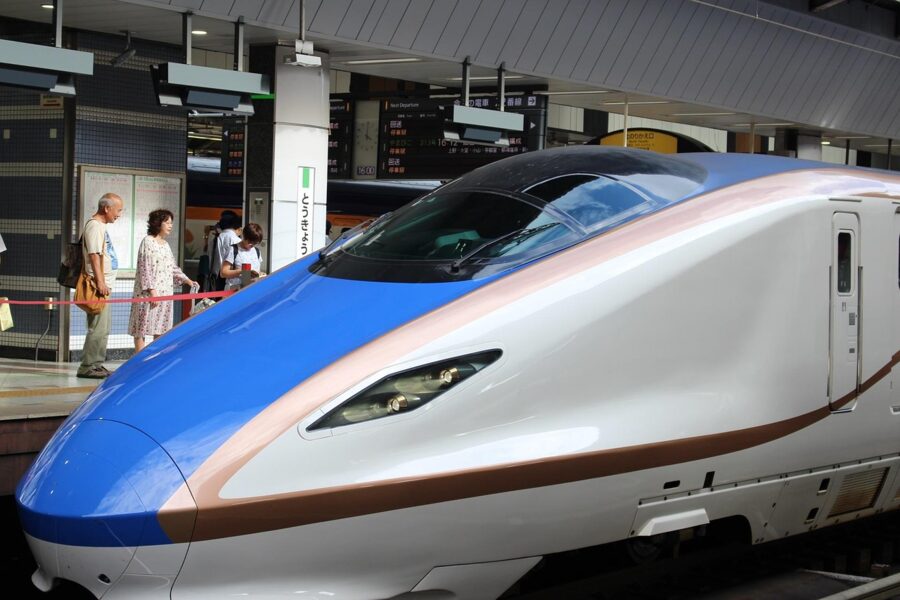
From Iiyama, the Nozawa Onsen Liner leaves from stop 4 outside the Chikumagawa exit and takes about 25 minutes to the central terminal in the village for ¥600. There are ten buses a day each way from 1 December 2026 to 31 March 2027: from Iiyama between 08:30 and 21:20, from the village between 06:30 and 19:35. No booking is needed; pay in cash, by Suica or by card, or buy a ticket from the machine at the stop.
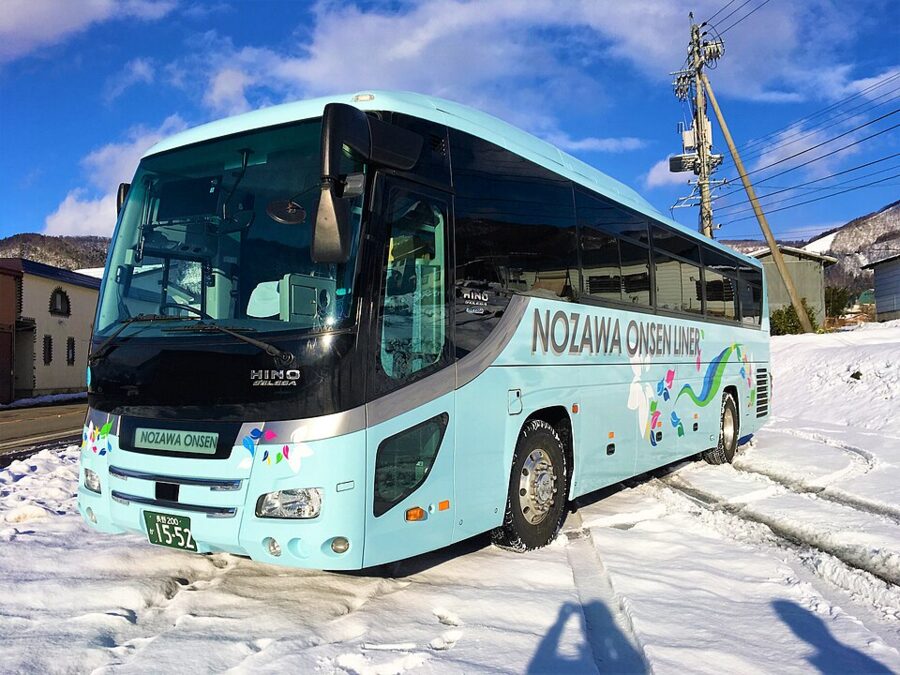

The resort warns that the 09:30 and 11:15 buses from the village are often very crowded. The alternative is the Nagaden town bus from stop 2, which goes round by Kijimadaira and takes about 40 minutes; you pay when you get off.
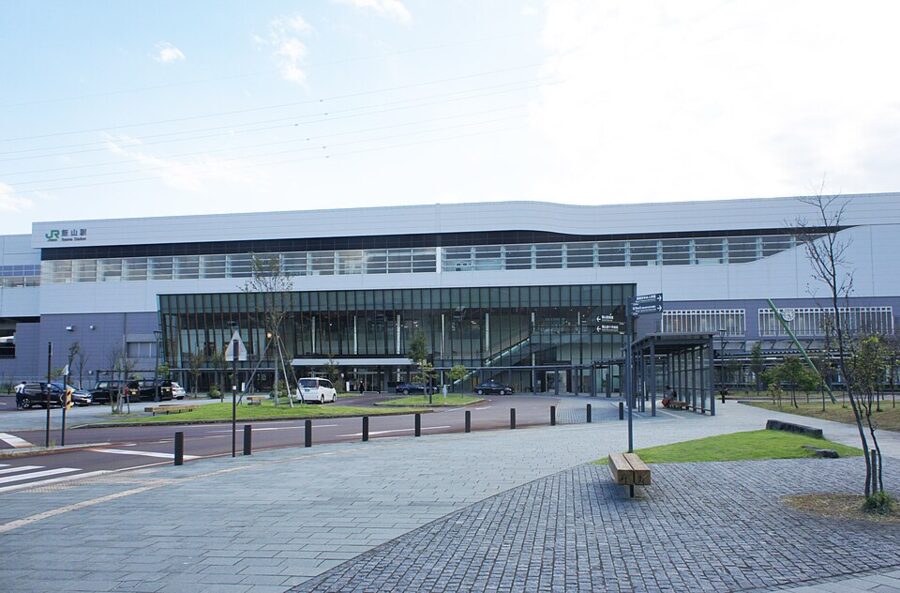

By car, the village is about 20 km from the Toyota-Iiyama interchange on the Joshinetsu Expressway, crossing the Chikuma river on the way in. You will need winter tyres from December. The resort’s car parks are free for day use most of the time; it lists P1 at Nagasaka at ¥1,000 a car at weekends and holidays, with P2 and P3 charging from the first night.
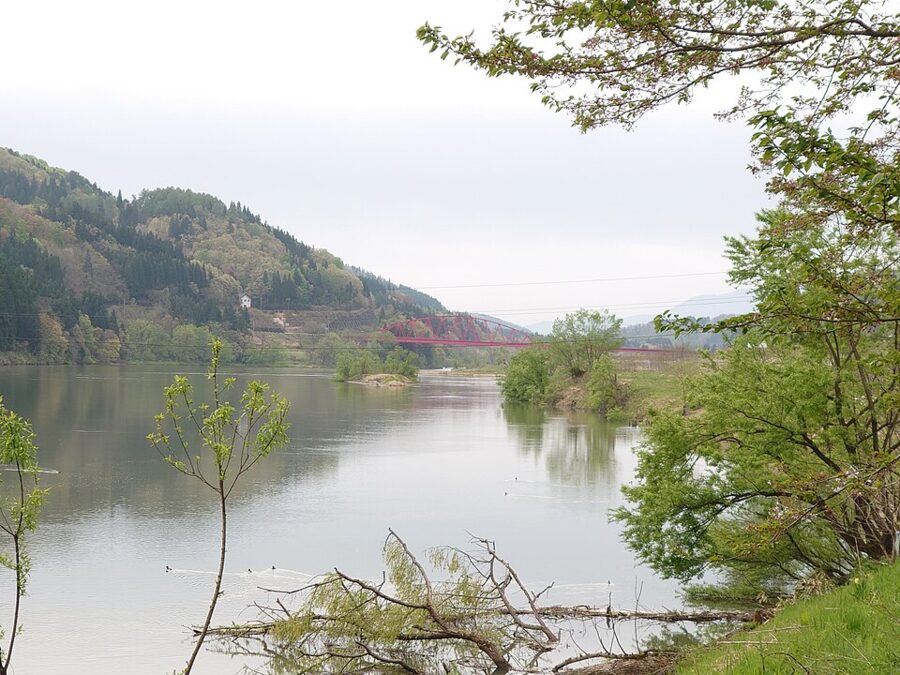

In the village you walk or ride. A free shuttle bus runs between the central terminal and the Nagasaka base from 12 December 2026 to 28 March 2027, more often at weekends and over New Year. The Yu Road walkway lifts you up to Hikage for nothing. Ski boots on the icy lanes are a bad idea; carry them.
Days away: snow monkeys, Madarao and the rest
The Nagaden express bus goes from the village straight to the snow monkeys at Jigokudani every day from 5 December 2026 to 5 April 2027. It leaves the Nozawa Onsen stop at 09:48, calls at Iiyama Station and reaches Snow Monkey Park at 10:50, for ¥2,000 from the village. It comes back at 14:15 and gets in at 15:15, in time for a bath.
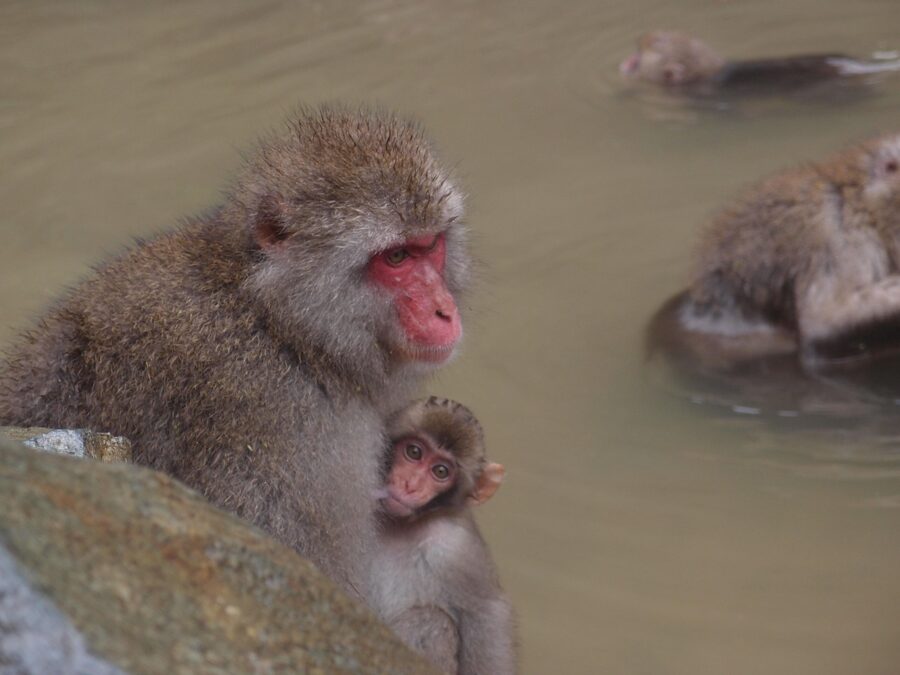
Madarao Kogen is a smaller ski area on the far side of the Chikuma valley, on the slopes of Madarao, one of the five Hokushin peaks. From 26 December to 7 March a Nagaden bus leaves the central terminal at 08:00 and reaches the Madarao Kogen Hotel at 09:05 by way of Iiyama Station, returning at 17:20 to arrive in the village at 18:15.

Shiga Kogen, the biggest linked ski area in Japan, is close on the map but not by road in winter. The high prefectural road towards Okushiga, Route 502, is closed all winter, and part of it lies under Nozawa’s own runs, so the trip means a long way round by the valleys. Hakuba is a different trip entirely, on the far side of Nagano city.
Summer and autumn on the mountain
Once the lifts stop in May, the mountain becomes a beech forest with a gondola up the middle. The Nagasaka gondola’s 2026 summer season ran from 13 to 21 June and from 18 July to 25 October, 09:00–16:00, closed Tuesdays to Thursdays from late August to mid-September. A return ticket was ¥2,500.
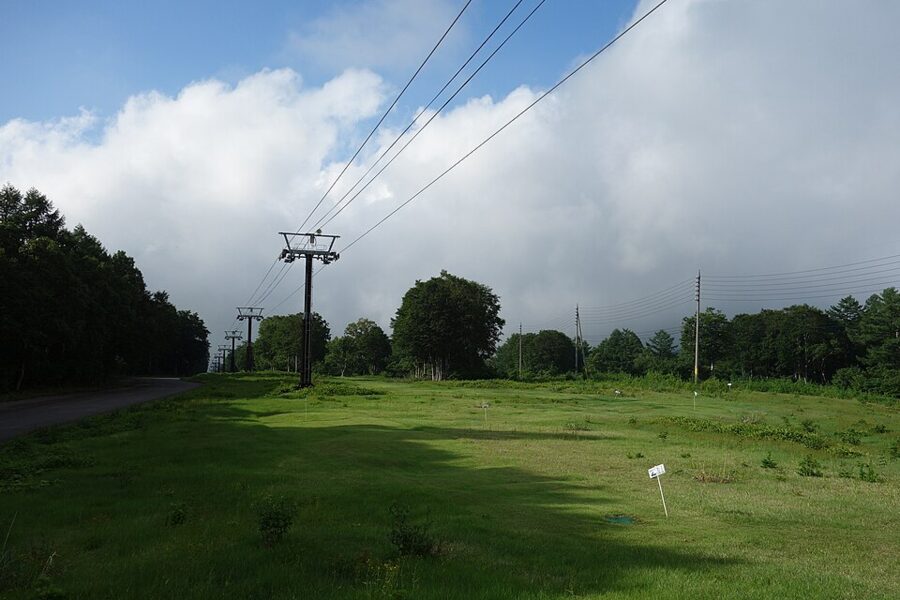

The walks start from the top. The Uenotaira plateau holds a large stand of virgin beech forest, and the resort marks seven trekking courses through it, open from mid-July to early November. Most are gentle: the beech forest course is 2.3 km one way, about 60 minutes, and the Sutaka lake course 3.5 km, about 80 minutes.
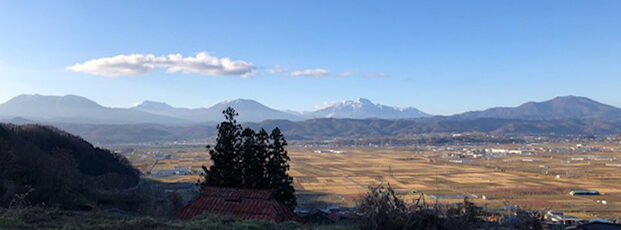
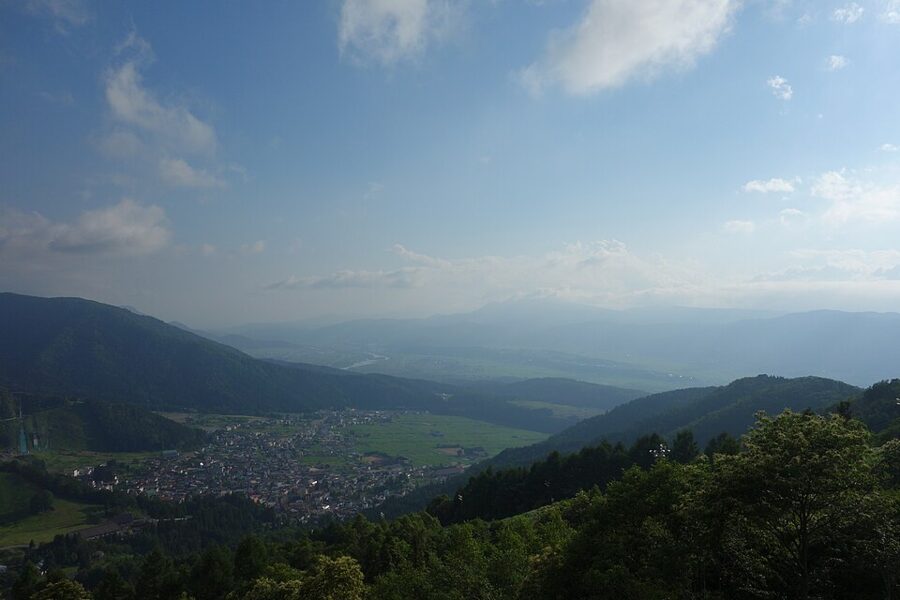
Two are worth the effort. The Kokenashi observatory, on a 1,450 m knoll right of the Yamabiko gondola station, is about 15 minutes away and looks down on the village and the Chikuma river, and on a clear day across the five Hokushin peaks to the Northern Alps. The G course to the Kenashi observatory is the only one graded advanced: 2.0 km one way and steep the whole way, about 90 minutes walking, map time.


This is bear country, as is most of northern Nagano. Carry a bell in the beech forest, make noise on blind corners and keep food in your pack. The forest is also the village’s water supply; the tourism bureau’s line is that rain and snow take about fifty years to filter through it to the springs.
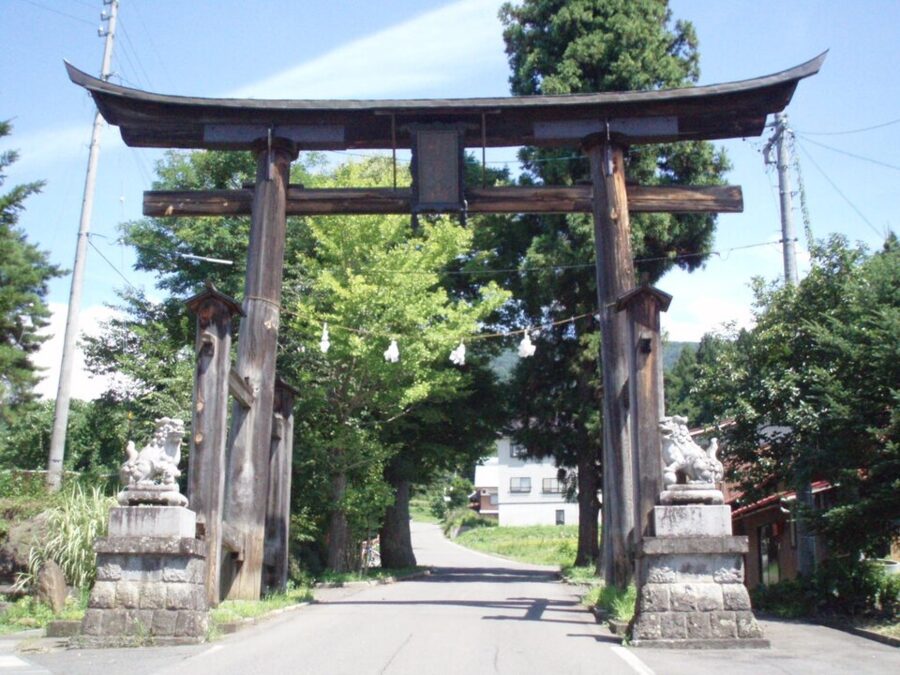

For a harder walk with history, Kosuge village, ten minutes from Nozawa by car, has a trail up to Kosuge Shrine (小菅神社) on Kosugeyama, a spur of Kenashiyama and one of the three great training grounds of the mountain ascetics in old Shinano. The resort calls it challenging in places and about an hour. Go in spring, summer or autumn; it is not a winter walk.
Summer also brings races. The Nozawa Spa Trail Race on 12 September 2026 was a 12 km trail run with a dog category, and the Enduro National Series brought mountain bike racing to the gondola trails on 22–23 August. The mountain bike park runs on the gondola all summer at ¥5,000 a day.
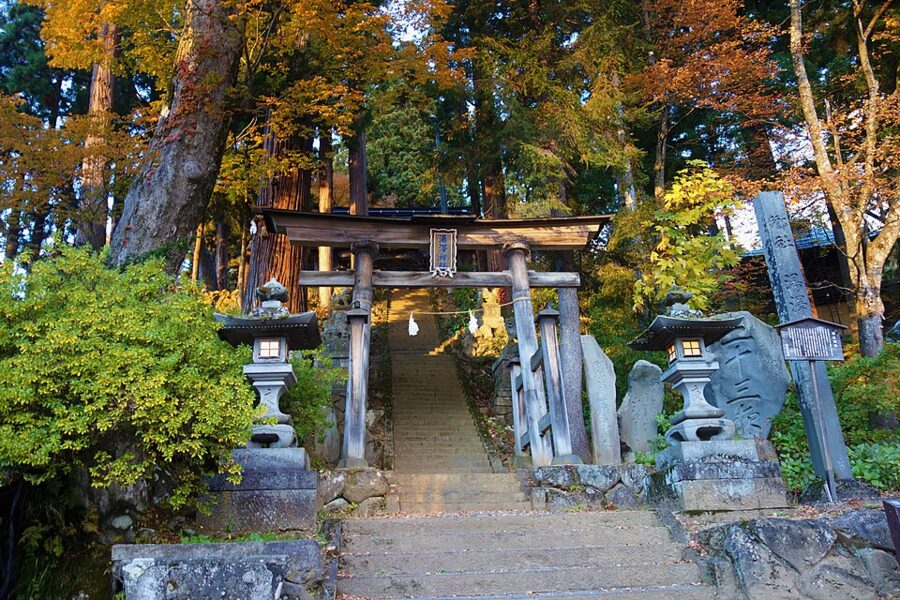

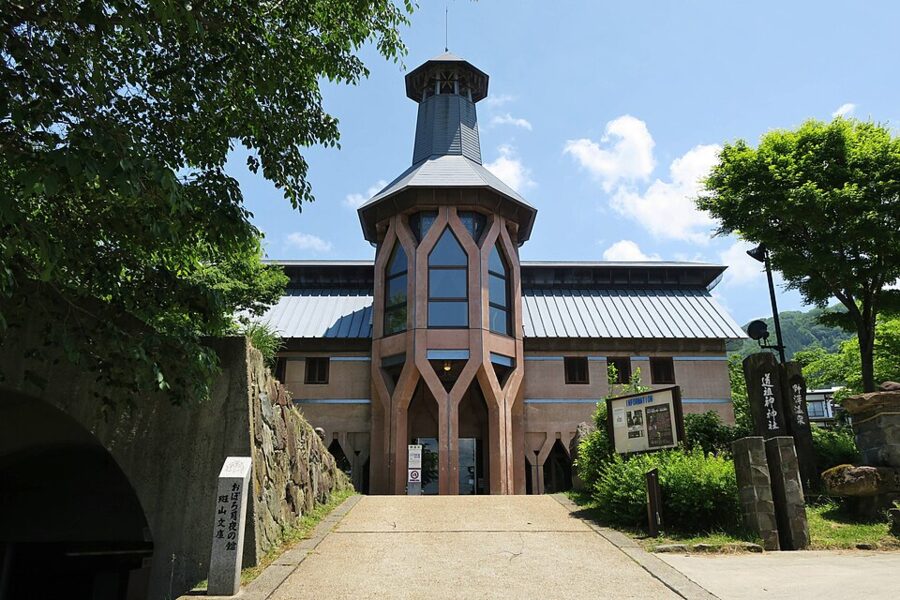
The village has its own calendar. Yuzawa Shrine (湯澤神社) holds its lantern festival on the night of 8 September, with lion dances and fireworks. A Sunday morning market runs from May to October. The Oborozukiyo no Yakata museum honours Takano Tatsuyuki, who wrote the words of the school songs “Furusato” and “Oborozukiyo” and died here: ¥300, closed Mondays.

Autumn is the quiet season and the local one. The beech forest turns in October, the nozawana is harvested and washed in the bathhouse laundries, the yakudoshi men go up the mountain to fell the festival trees, and the baths are almost empty. The lifts are shut and the first snow is weeks away.
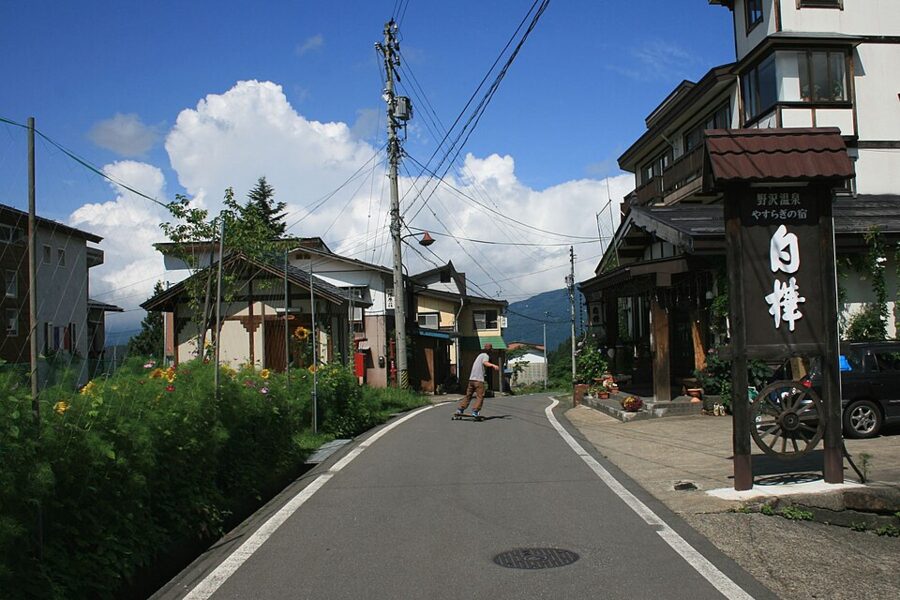

Back at the top of the Yamabiko quad in January, the choice is still the same two doors. Now you know what is behind them: no patrol, no bulletin for this mountain and an ordinance that sends you the bill. If you take them, take a beacon, a partner and a notification with the patrol, and leave by midday, well before the 15:20 closing. If you do not, Skyline is waiting, and so is a 47°C bath at the bottom of it.